
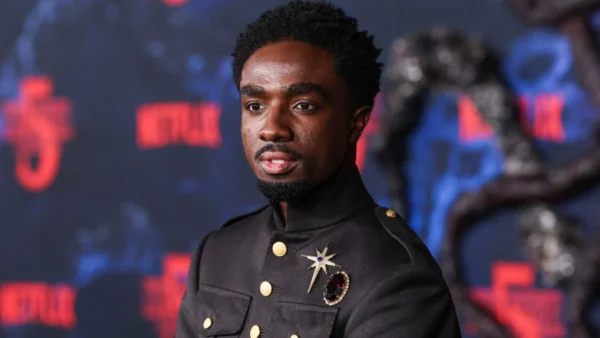

Caleb McLaughlin: From Broadway Cub to Screen Warrior
Caleb McLaughlin did not so much wander into show business as arrive with the unnerving efficiency of someone who had already read the map, circled the landmarks, and packed sensible shoes. Born in Carmel, New York, on October 13, 2001, McLaughlin built his career the old-fashioned way: by learning how to do things properly before the world started calling him famous. Long before millions knew him as Lucas Sinclair in Stranger Things, he was training in dance, developing stage discipline, and doing the sort of foundational work that tends to separate durable performers from decorative ones.
That early grounding matters. McLaughlin was not manufactured by viral momentum, nor hatched in a laboratory of algorithmic relevance. He came up through performance. He trained in ballet, tap, and jazz, and that physical command has followed him from stage to screen. Even when he is standing still, he often gives the impression that stillness is a deliberate professional choice rather than a temporary interruption. It is one of the quiet signatures of his work: alert posture, sharp timing, and the sense that he is always connected to the rhythm of a scene.
His public rise may look swift in retrospect, but the architecture underneath it is remarkably sturdy. Broadway gave him discipline. Television gave him range. Streaming gave him global visibility. Film gave him room to deepen. Taken together, those stages form the outline of a career that has grown more interesting as it has grown more visible, which is rarer than the entertainment industry likes to admit.
Before Hawkins: Training, Stage Work, and Early Screen Appearances
The Broadway Beginning
One of the most useful things that ever happened to Caleb McLaughlin was not becoming famous too quickly, but becoming skilled early. He made his Broadway debut as Young Simba in The Lion King, a role that is less a cute childhood credential than a formidable apprenticeship. Child performers in that production are not asked to drift onstage and beam pleasantly. They are expected to carry music, movement, storytelling, and precision in one of the most demanding theatrical environments in America. Broadway has a way of exposing the merely adorable. McLaughlin came through it with credibility.
That role also placed him inside a production built on scale, discipline, and repetition. Eight shows a week teaches stamina. It teaches consistency. It teaches that talent is wonderful, but timing is non-negotiable. It also teaches a young performer how to work as part of a machine larger than himself, while still remaining emotionally alive within it. Those lessons do not vanish when the costumes come off. They linger in screen work, often in the form of reliability, and reliability is one of the most valuable and least glamorous virtues an actor can possess.
Television as an Acting Gymnasium
Before the breakout, McLaughlin moved through the useful proving grounds of episodic television. He appeared in shows including Law & Order: Special Victims Unit, Unforgettable, Forever, Blue Bloods, and Shades of Blue. These were not massive star vehicles for him, nor were they meant to be. They were part of the craft-building phase, the period in which an actor learns how quickly a scene must land, how to calibrate for different genres, and how to arrive prepared in worlds already moving at full speed.
There is a particular kind of education in guest work. One learns to establish a character with economy. One learns that there is no time for preciousness, and very little patience for confusion. You arrive, understand the tone of the show, do the job cleanly, and leave the camera with something memorable in its possession. For young actors especially, that process can be invaluable. It turns nerves into repetition, and repetition into fluency.
The Breakthrough: Lucas Sinclair and the Global Reach of Stranger Things
Not Just One of the Kids
Then came Stranger Things, the series that turned its young ensemble into household names and transformed Caleb McLaughlin into an international presence. As Lucas Sinclair, he was not cast merely as one more bike-riding member of a supernatural adventure club. Lucas brought skepticism, bravery, dryness, and common sense to a story otherwise packed with monsters, conspiracies, and a great deal of running through dimly lit places where any rational person would have moved to another county.
What made McLaughlin’s work especially effective was that he did not play Lucas as a token realist or a one-note sidekick. Lucas could be funny, stubborn, warm, wary, and unexpectedly vulnerable. He often served as a balancing force in the group dynamic, grounding the heightened events in a recognizable human response. In a show full of dramatic mythology and nostalgic atmosphere, that practical honesty mattered. It kept the character from becoming decorative and made him integral to the emotional engine of the series.
Growing Up on Screen Without Losing the Plot
One of the unusual burdens of Stranger Things was that its young cast had to grow up publicly while the show itself expanded into a cultural giant. That process ruins some performers. Fame magnifies awkward transitions, and long-running series can trap young actors inside earlier versions of themselves. McLaughlin, however, managed something more difficult. He let Lucas mature without abandoning the character’s essential shape. As the series moved from child adventure into darker, more emotionally heavy territory, his performance grew with it.
By later seasons, Lucas had become one of the show’s clearest examples of how adolescence complicates loyalty, identity, friendship, and fear. McLaughlin handled those shifts with a steadiness that did not beg for applause. He simply did the work. He made Lucas feel older, more conflicted, and more emotionally available, while preserving the intelligence and resolve that defined him from the beginning. That kind of continuity is harder than it looks. Television often rewards volume. McLaughlin frequently worked with restraint.
Recognition Beyond the Screen
The success of Stranger Things brought substantial recognition. McLaughlin shared in the ensemble honors the cast received, including a Screen Actors Guild Award win for outstanding performance by an ensemble in a drama series. He also earned individual recognition, including a NAACP Image Award for outstanding performance by a youth. Those acknowledgments fit the larger pattern of his career: a performer who became extremely popular without allowing popularity to become the whole story.
Expanding the Resume: Film Work and Sharper Dramatic Terrain
High Flying Bird and the Move Into Film
After becoming widely known through series television, McLaughlin began widening the frame. In Steven Soderbergh’s High Flying Bird, he played Darius, taking part in a film that was less interested in sports spectacle than in the business and leverage surrounding professional athletics. It was a smart transitional credit. Rather than chase something loud and obvious, he stepped into a film driven by dialogue, intelligence, and structure. It suggested an actor interested in career shape, not just screen time.
That matters because many young actors emerging from hit shows are encouraged to choose projects that merely confirm their marketability. McLaughlin’s film choices have often shown a different instinct. He has moved toward material that lets him stand near strong filmmakers, distinct worlds, and performers with weight. In practical terms, that is how an actor builds a second act before the first one has finished making money.
Concrete Cowboy and a First Major Lead
His most significant early film leap came with Concrete Cowboy, in which he played Coltrane “Cole” alongside Idris Elba. The film follows a troubled teenager who is sent to live with his estranged father and encounters the urban horse-riding culture of Philadelphia. It gave McLaughlin something precious: space. Space to lead, space to react, space to hold contradictions, and space to carry a feature without hiding behind the momentum of a franchise ensemble.
In Concrete Cowboy, he showed a more textured dramatic presence. Cole is guarded, angry, uncertain, and curious all at once. McLaughlin did not flatten him into a problem child redeemed by plot mechanics. He played him as a teenager colliding with culture, masculinity, abandonment, and belonging. The performance had patience. It listened. It let the film breathe. That was perhaps the clearest early sign that his screen presence could support more than charismatic participation; it could sustain narrative weight.
Further Film Work: Historical, Athletic, and Supernatural Worlds
McLaughlin continued to diversify his filmography with roles in Shooting Stars, The Book of Clarence, and The Deliverance. In Shooting Stars, he played Dru Joyce III in the dramatization of LeBron James’s early basketball years. In The Book of Clarence, he appeared as Dirty Zeke in Jeymes Samuel’s stylized biblical epic. In Lee Daniels’ The Deliverance, he played Nathaniel “Nate” Jackson, stepping into darker supernatural material.
These choices are notable not because they belong to one tidy brand, but because they do not. Sports drama, revisionist biblical cinema, horror-inflected family trauma: this is not the path of someone content to remain the familiar face from one famous show. It is the pattern of a performer testing genre, tone, and scale. Some actors build a career by being endlessly recognizable. Others build one by proving they can belong almost anywhere. McLaughlin appears increasingly interested in the second approach.
Voice Work, Range, and the Useful Art of Not Standing Still
Though live-action performance remains the center of his profile, McLaughlin has also taken on voice work in projects such as Final Space, Summer Camp Island, and The Boys Presents: Diabolical. Voice acting is an excellent detector of whether a performer truly understands character or has simply been leaning on face, posture, and good lighting. Remove the camera and many vanish into decorative sound. McLaughlin does not. His voice work suggests flexibility, musicality, and a willingness to play with tone.
That versatility connects directly back to his foundation in movement and stage performance. Actors with broad physical and rhythmic awareness often adapt well to voice work because they understand that performance lives in tempo as much as expression. The body may be offscreen, but it is still present in the sound. McLaughlin’s background has clearly helped him move between mediums without looking as though he has wandered into the wrong building.
Public Presence, Resilience, and the Shape of an Adult Career
Fame With Friction
One of the more serious aspects of McLaughlin’s public life has been his willingness to speak candidly about the racism he experienced from portions of fandom during his rise on Stranger Things. That reality added an ugly and revealing dimension to the story of his success. It also highlighted something important about him: he has shown unusual poise in discussing the cost of visibility without reducing himself to grievance or performance. He has remained thoughtful, direct, and grounded in how he frames those experiences.
That sort of steadiness matters because celebrity culture often rewards either silence or melodrama. McLaughlin has generally chosen clarity. He has not hidden from the subject, nor has he allowed it to define the full scope of his identity as an actor. That balance requires maturity, especially for someone who entered public scrutiny so young.
The Next Phase
By the time many actors are still trying to convince the industry they are more than one role, Caleb McLaughlin has already assembled the evidence. He has Broadway discipline, television fluency, franchise recognition, voice performance credentials, and a growing list of film work across genres. He also has the one thing careers need more than trendiness: momentum with shape. His path does not look random. It looks built.
There is a temptation, when discussing actors who become famous young, to speak as if adulthood will eventually begin once the signature role is behind them. In McLaughlin’s case, adulthood in craft has been visible for some time. The child performer became a working actor. The working actor became a breakout star. The breakout star is now doing the harder job, which is becoming an enduring one.
Why Caleb McLaughlin Matters
Caleb McLaughlin’s career is compelling not merely because it is successful, but because it has developed with intelligence. He did not emerge as a novelty. He emerged as a performer. The distinction is enormous. Novelty gets photographed and forgotten. Performers keep being cast. His work shows preparation, thought, and a refusal to remain artistically house-trained by early fame. He has managed to be recognizable without becoming repetitive, polished without becoming bland, and ambitious without looking frantic.
That combination gives his career a promising tension. He has enough visibility to be commercially valuable and enough craft to keep the value from feeling accidental. In an industry forever tripping over the shiny object nearest the window, that is no small feat. For a concise official overview of his credits, the most useful single reference remains his IMDb profile.
So here stands Caleb McLaughlin: Broadway-forged, screen-tested, globally recognized, and still moving with the alertness of someone who understands that a career is not one triumph but a series of choices. He began as a young lion, became a boy on a bicycle facing monsters, and has continued into film with increasingly assured steps. The impressive part is not that he arrived early. It is that he keeps arriving better prepared than expected, like a performer who has politely accepted the chaos of modern fame, taken notes on its absurdities, and decided to outlast all of them.
Now Read The VO Dirt!Voice Actors D.C. Douglas Knows and Loves!


OR CHECK OUT THE LATEST BLOG DROPPING:D.C. Douglas Returns as Lysandre in Pokémon Masters EX
Film & Television work. 🎙️HEAR MY VOICE:
Voice Over work. 🎪CONVENTIONS:
Book me for your con! 🩶THE DC STORE:
Learn about Cameos!
I'm such a whore. 🎪LIVE IN PERSON:
Public nuisance posts. 🗣️INTERVIEWS:
Posts from my butt. 🍷GREEN ROOM:
BTS & L.A. life. 🧪RESIDENT EVIL WORLD:
Wesker fetish? 💫TALENT SPOTLIGHT:
Stalker crib notes.