

The Inconvenience of Digital Omnipresence
Elwood Edwards was born in 1950 in Glen Burnie, Maryland, a fact that would be entirely unremarkable if he hadn’t eventually become the most heard man in the history of the early internet. He did not set out to be a haunt in the machines of millions. He merely possessed a voice that sounded like a very polite neighbor telling you that your lawn needed mowing, but in a way that made you want to buy him a beer. This vocal quality led him into a long career in radio and television news, a profession where people are paid to look concerned about local traffic. By the time he reached his late thirties, he was working at a television station in Ohio, unaware that a domestic recording session would soon transform him into a digital ghost.
The Living Room Incident of 1989
In 1989, the world was wide and largely disconnected. Steve Case, the head of Quantum Computer Services (which would later become America Online), decided that his software needed a human touch. He wanted a voice to greet users. Edwards’ wife, Karen, worked for the company and overheard Case mentioning this need. She volunteered her husband. Elwood Edwards sat in his living room and spoke four phrases into a basic cassette deck (a device capable of holding both magnetic tape and the weight of a thousand digital souls). He recorded: Welcome. You’ve got mail. File’s done. Goodbye. For this monumental labor, which would define the acoustic landscape of the 1990s, he was paid twenty dollars. This is a staggering rate of five dollars per phrase, which is significantly more than most poets make but considerably less than the value of the psychological real estate he would come to occupy. Information regarding his early career can be found on his verified IMDb profile, which lists his transition from a local news technician to a global auditory icon.
Professional Performance Analysis: The Craft of the Invisible
From a technical standpoint, the performance of Edwards is a masterclass in mid-Atlantic neutrality. In the voice acting industry, there is a specific demand for the “non-voice.” This is a delivery that carries no regional baggage, no aggressive personality, and no detectable ego. Edwards achieved this with a terrifying ease. His vocal placement sits squarely in the mask of the face, favoring a bright, resonant tone that could cut through the low-fidelity speakers of a 1992 desktop computer. Because the audio files had to be extremely small to travel over dial-up modems, the frequency range was severely compressed. A voice with too much bass or too much airy sibilance would have turned into a digital hiss. Edwards provided a naturally compressed, mid-range heavy delivery that survived the 8-bit slaughter of early audio codecs. His timing was equally precise. There is a micro-pause between “You’ve got” and “mail” that creates a sense of anticipation, a tiny mechanical hook that triggered a dopamine response in an entire generation of users. It is the sound of a man who knows he is being recorded but is pretending he is just passing through the hallway.
The Simpsons and the Tonight Show
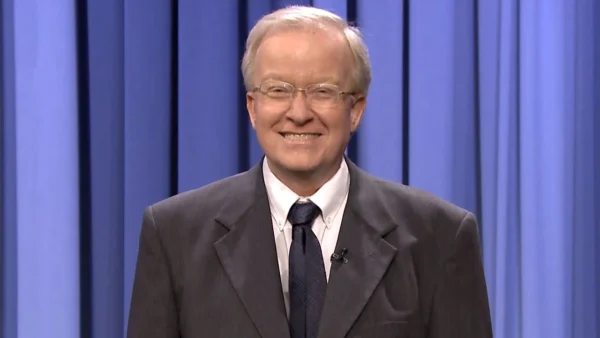
The success of the AOL voice was a catastrophe for Edwards’ anonymity. He became a piece of kitsch, a human sound effect that could be summoned for late-night television bits. In 2011, he provided his vocal services for The Simpsons in the episode The Food Wife, playing a fictionalized version of his own vocal legacy. He also appeared on The Tonight Show Starring Jimmy Fallon in 2015, where he was forced to stand behind a cardboard cut-out of an AOL logo and repeat the phrases that had likely lost all meaning to him decades prior. He did this with a smile. It was a display of professional grace that borders on the pathological. He worked as a booth announcer for WCNC-TV in Charlotte, North Carolina, for many years, performing actual news duties while the rest of the world used his pre-recorded ghost to confirm the arrival of chain emails and spam.
Industry Impact and the Final Goodbye
The significance of Edwards’ work lies in its utility. He was the first bridge between the cold, silent world of computer code and the warm, messy world of human interaction. Before him, computers beeped. After him, they spoke. This was a dangerous precedent that led directly to the modern era of talking refrigerators and cars that scold you for drifting out of your lane. Edwards’ voice provided a safe, paternal entry point into the internet. It was a customer service tone that felt like a warm hug, even when it was delivering a goodbye that meant your phone line was finally free again. His career was not a series of flashy roles but a steady, consistent presence in the background of the information age. He remained a humble participant in his own fame, often expressing mild surprise that anyone still cared about a twenty-minute recording session from 1989. Following a long career in the shadows of the spotlight, Edwards passed away in November 2024 at the age of 74. He left behind a legacy of four phrases that everyone knows and a career that everyone heard but few truly watched. He was the most famous man you would never recognize in a grocery store, a fate that is arguably the highest achievement any sensible person could hope for.
In the end, Edwards did what few actors ever manage to do: he exited the stage while leaving his voice behind to handle the busywork. He proved that you don’t need a three-hour epic to be remembered. You just need a cassette deck, a living room, and the ability to tell someone they have mail without sounding like you are about to steal their identity. It was a good run for a man who was essentially a human notification bell. File’s done.
Now Read The VO Dirt!Voice Actors D.C. Douglas Knows and Loves!


OR CHECK OUT THE LATEST BLOG DROPPING:D.C. Douglas Joins Disney+’s Vampirina Season 2 as Speaker of Books
Film & Television work. 🎙️HEAR MY VOICE:
Voice Over work. 🎪CONVENTIONS:
Book me for your con! 🩶THE DC STORE:
Learn about Cameos!
I'm such a whore. 🎪LIVE IN PERSON:
Public nuisance posts. 🗣️INTERVIEWS:
Posts from my butt. 🍷GREEN ROOM:
BTS & L.A. life. 🧪RESIDENT EVIL WORLD:
Wesker fetish? 💫TALENT SPOTLIGHT:
Stalker crib notes.