


L.A. actor D.C. Douglas works on-camera (CSI: Vegas, Charmed, cult indies) & in voice over (Star Wars, Mass Effect, JJBA, Resident Evil). | Con Bookings.


How the hell did I get here…?
Throughout the years I have had numerous requests for me to help guide others into becoming my competition. The following is from an ebook I put together in 2005 (before TikTok, biatches) based on a career I fell into while working on my on-camera career in the 1990s! (The tech info given was based on my knowledge in 2002.) I hope any aspiring voice over actors interested find it useful! Please don’t email me, though, as I’d be pretty useless at helping your career! I’ve been guessing all these years, anyway!
Jump to Step:
VOICE OVER: IT ALL STARTS WITH YOUR VOICE
If you have ever been told that you have a great voice, then you may have thought of making use of that great voice in a professional way – as a singer, announcer or as a voice over talent. Voiceover, or adding your voice to advertisements and recorded messages, can be a very lucrative field for a trained talent.
In the commercial world all kinds of voices are needed: low voices, whiny voices, gravelly voices, flat voices and even average voices. So, even if you don’t have a classic “good voice” you can enter the field if you have determination.
First, explore your instrument. Not just your voice, but your whole being. Do this by taking an acting and/or improvisation class at your local college/learning annex/community center. Stay with it for 3 months. Aside from freeing yourself up, you’ll probably meet some fun people.
3 Months of Acting/Improvisation
Why acting classes? You need to know how to create the characters who “speak” in a commercial. Just taking an animation class won’t do it. You need to start the process organically. It’s not about the voice, just yet, it’s about the intention behind the voice that gives the voice a shape.
After you’ve opened yourself up for three months in an acting class, it’s time to move into specifics with a voice over class.
This is where I’ll begin to speak to two types of people: Those who want to move to L.A., New York, Atlanta, Chicago, or San Francisco and pursue a union voice over career, and those who want to create an internet voice over career right there in Smalltown, USA. For simplicity sake, we’ll refer to them as Red state and Blue state… Actually, I think CITY (union) and COUNTRY (non-union/internet) might be better.
Voiceover class
CITY:
This part should be very easy for you. Just do a search for “Voiceover Class” and “your city” with Google. Of course, there may be classes offered at your local universities and performing arts centers. Ask around for good word-of-mouth about them. Then sign-up with the best and attend! (Avoid classes that end with you paying another $1000 for a demo reel).
In L.A., the best resource is Voice Over Resource Guide. It lists all the studios as well as all the classes in L.A. At the top for classes are The Voicecaster and Kalmenson & Kalmenson. In addition, read some books on the subject.
COUNTRY:
Here’s where you will find some challenges. Try your local college/learning annex/community centers to see if one is offered. Also ask your acting teacher if they know of any coaches who do voice over coaching. It may even be your own acting teacher! You might have to drive a bit to the next big town to find a class or coach. But, it’s imperative to get some formal training. Just reading a book won’t do it for you.
You need a “director” in the beginning to help you become aware of where your technique is weak or failing. By all means, read books, too! They will give you great insight into the mechanics. But, it all comes down to those sound vibrations and how they land on the listener’s ear.
In addition to your voice over class, start practicing at home. Listen to any and every commercial on the TV and radio. Mimic them. Pick up magazines and read the ad copy aloud as though it were a commercial. Get so used to your voice that silence sounds wrong.
Most people want to skip this whole part and get right to the money making part. Believe me, if you skip this part, no one will want to pay you for what you’ll be offering. Ego and confidence are not a substitute for talent and technique.
Some books on the subject:
There’s Money Where Your Mouth Is: An Insider’s Guide to a Career in Voice-Overs — by Elaine A. Clark
Secrets of Voice-Over Success : Top Voice-Over Actors Reveal How They Did It — by Joan Baker
The Art of Voice Acting: 2nd Edition — by James Alburger
The Page You Made: Word of Mouth –by Susan Blu, Molly Ann Mullin
Work in Voiceover Acting: written by a Casting Director
FINDING YOUR RANGE AND NICHE
Once you’ve gotten a handle on your voice, you need to know what your range is and, by association, what your market is.
Are you the classy BMW voice, the GenX hamburger guy, the Don Pardo game show host? You could be all three and more. Knowing all that you can do will help you promote yourself with confidence and direction.
Start with your normal speaking voice. What does your coach say? Are you the “everyman” voice? The “hip, edgy” voice? The “natural announcer” voice? Whichever comes the easiest may be your bread and butter. Foster it. What you and your coach decide will become the centerpiece of your promotion.
But don’t stop there! Now start stretching your voice. Try accents, character voices – both broad and subtle (this is where the acting classes come in handy). Anything you can do with your voice may be called upon for any one of the different voice over market niches out there!
Here are the main areas you might find work:
Radio/television commercials
Promos/trailers
Business narration
Cartoons
IVR/voice mail greetings
Web audio
If you’re COUNTRY you probably won’t get much cartoon work and if you’re CITY you probably won’t get much IVR/voice mail greetings work. But ALL of these areas may require ANY TYPE of voice style! So, the broader your range, the broader your work potential.
This is an important step. It is here that you determine your whole approach to your career, whether it be CITY or COUNTRY.
For example, you have a gravelly, low voice that’s warm. You might sell yourself as the “Your Bourbon Straight-Up voice”. Or you have a super-sweet female voice you would be “The Voice of a Princess”, etc.
It also helps to know what celebrities you sound like. See what kinds of commercials they perform voice over on. Listen closely: Alec Baldwin, Keifer Sutherland, Stockard Channing, Susan Sarandon – they all do voice overs.
You may want to specialize. For CITY folks, you can find an animation class or a promos class. COUNTRY folk will have to do a bit of self-teaching here. Read Terri Apple’s Making Money in Voiceovers.
Start collecting copy (scripts) that fit your style. Even within your style there are sub-styles. Cover them all. Also look for copy that best shows your other “stretch” voices. This all will lead up to making your demo reel.
The business starts with your demo reel…
THE DEMO REEL
Here is where it gets complicated and potentially expensive. If you’re going the CITY route, you’ll want to ask around as to where to get your demo done. Where do other voice over actors go for theirs? How does their demo sound? And, of course, what’s the cost? If it sounds too expensive, then it is. In L.A., I recommend using Voice Over Resource Guide to find a demo reel studio.

For CITY folk, the demo is primarily used to get an agent. That’s about it, as most clients/jobs/gigs will come from auditions you’ll do at the agency or local casting facility.
For COUNTRY folk, your demo(s) will continually be your selling tool on your website. You will probably want to have one for each of the markets I wrote about previously. And getting your reel done will be hard at first. In some geographical areas, there won’t be anybody who can edit them for you, let alone offer good direction. But that’s where your career will differ from CITY folk.
Let’s start with the basics for both CITY and COUNTRY folk.
Your demo shouldn’t be longer than a minute. Yes, a minute! Others will say 2 minutes, but no one listens that long unless you have SO MANY DIFFERENT voices.
Each clip on your reel should be no more than 15 seconds, probably less.
Each clip should show something NEW about your voice.
The clips should get shorter the longer the reel goes so the pace quickens.
Your demo should only contain things appropriate for that market! i.e. Commercials for a commercial demo, cartoon voices for a cartoon demo, narration for a narration demo.
CITY folk will probably only need a Commercial demo and a Narration demo (and Cartoon demo if they do funny voices).
COUNTRY folk should have a demo for each market listed previously.
The COUNTRY folk, you have some work cut out for you! In order to have a home voice over studio business, you are going to have to learn to record yourself, edit your recording and burn CDs and also upload them to the internet. This is something you’ll be doing every day…. You might want to read this paragraph again.
BUILDING YOUR STUDIO
This is where your business comes to life! Here’s what you’ll need:
A closet or sound booth.
A microphone.
A mixer (optional).
A pre-amp (optional).
Headphones.
A music stand and a microphone stand.
A computer optimized for audio recording (processor/RAM).
A sound card or ProTools mBox.
A software program or ProTools.
Monitor Speakers (for accurate sound editing).
A website and DSL or Cable Broadband!
All this will require two other people (Helpers): One helper who knows about audio equipment and recording software, and a web designer.
A CLOSET OR SOUND BOOTH
When you’re starting out, you’ll want to watch your money, so a sound booth shouldn’t be considered. They usually run about $1,200 or more.
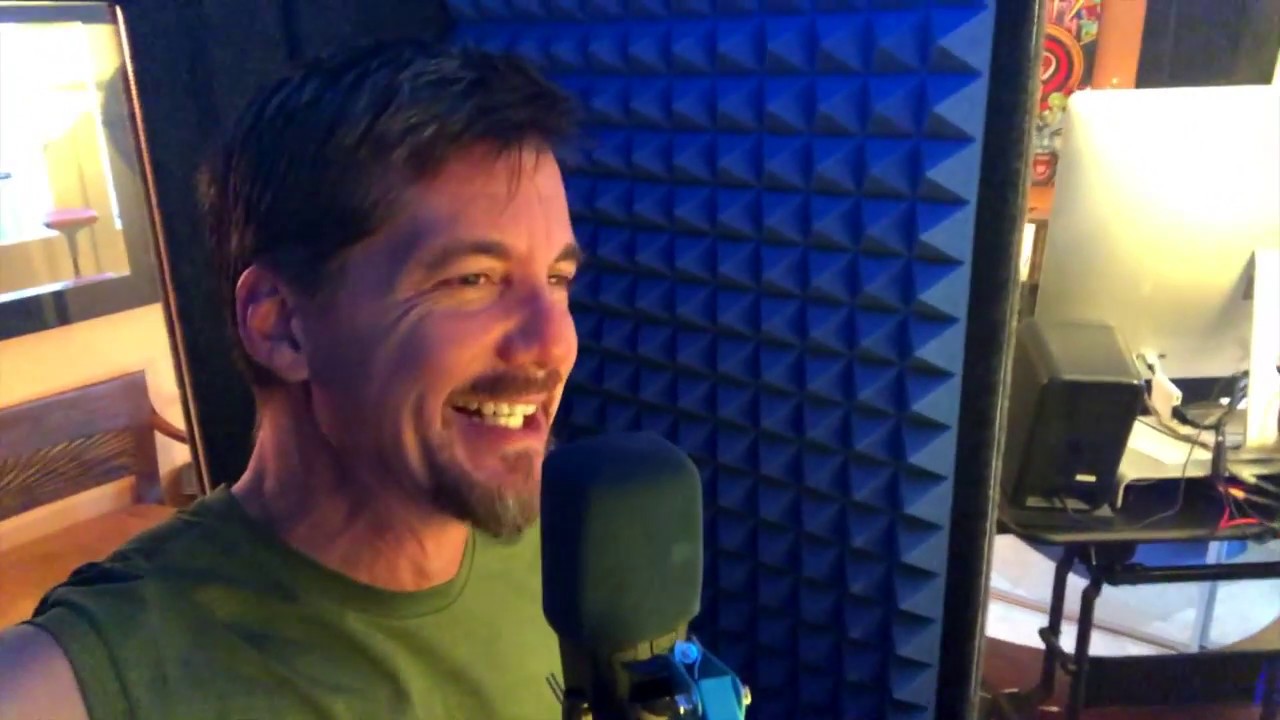
Voiceover Talent DC Douglas and his Whisper Room.
However, a closet is always easy to convert. You need a space that is away from the plumbing but close to your computer. Carpet the walls of the closet so you don’t get your voice bouncing around. Carpet is much cheaper than studio insulation.
A MICROPHONE
I use an AKG 414 and it cost me $600 on eBay. Go to your local music store and let them know what you’re doing. Ideally, find someone who will come out to your house and help you put the whole studio together for a small fee.
A MIXER
Someone who knows how to make a good martini… Wait, sorry. I mean a mixer is good for being able to control your mic and headphone volume when you’re in the booth. (Side note: ISDN is not worth the cost at this stage. Technology is moving towards VOIP).
COMPUTER/SOFTWARE
Get a Mac. Any Mac that’s a G4 or G5 with 1 gig of RAM. If you want to go another way, talk with your Helper. Sound card: Some computers already have one; others will need an mBox ($500) which includes ProTools.
MONITOR SPEAKERS
Make sure you get real monitors. They don’t pump up/beautify the audio; you want to hear exactly what you sound like. I use Roland Micro monitors. Don’t use internal computer speakers!!!
WEBSITE
And here is the monster! Determine what you’ll want on your site: your style, your demos, and instructions on how clients can work with you. Check out your competitor’s websites. Using a website template can save you lots of hours and money. (Ensure your designer makes your site optimized for search engines/SEO).
Build Your CAREER
Now it’s time to edit your own reels! Listen to professional reels and match their techniques. If your reels sound like TV and radio ads, you’re fine. Use royalty-free music under your spots. Update demos often as you get work. Most importantly: Just do it. Most COUNTRY folk get stuck right about here.
FINDING AN AGENT
For CITY folk, this is the hardest part. Perseverance is enormous. Land an agent by packaging your CD catchy and representative. Get agency lists from your local SAG or AFTRA office. Mail that CD with a SHORT intro letter to every agent. Ask friends, teachers, or even your barber for referrals!
For COUNTRY folk, you’ll want to sign up with many agencies in many cities. They’ll email you auditions, and you’ll email your mp3 back. Sign up for Voices 123 and Voices.com. Your biggest challenge is to get clients: focus on pay-per-click and reaching out to local companies in your town.

These are essentially the steps I took to start both my COUNTRY and CITY careers. Half of being good at this is the ability to learn on the job; the other half is preparation. There is no easy way right to the money, but I’ve shown you some practical steps. YOU have to take them.
If you read this far, you might be interested in these:
VO: MENTORS & INFLUENCES
AI: TO THE ASPIRING VA
ADVICE FOR DISABLED/NEURODIVERGENT ACTORS
PIONEERING DISABLED/NEURODIVERGENT ACTORS
VO Career Logistics & Industry Reality
Launching a voice over career in the current market requires a blend of traditional acting technique and modern technical proficiency. While this guide provides the foundational steps, the landscape is shifting due to the rise of synthetic voices and remote-first production.
Modern Professional Requirements
- Technical Fluency: You are now your own audio engineer. Understanding RAW delivery, room tone, and Source-Connect is no longer optional for high-tier work.
- The Performance Edge: As AI dominates low-budget narration, human actors must focus on complex character work, comedic timing, and emotional subtext—areas where human nuance remains the industry standard.
- Diversified Portfolio: Successful beginners in 2026 often bridge the gap between VO and on-camera work, using their range to secure roles in AAA gaming and interactive media.
The Long Game
There is no singular path to success in voice acting. Many veterans spent years in small local markets or regional theater before finding their breakthrough role. Persistence, professional training, and the ability to adapt to new technologies are the only true shortcuts.
— TSG Management
Film & Television work. 🎙️HEAR MY VOICE:
Voice Over work. 🎪CONVENTIONS:
Book me for your con! 🩶THE DC STORE:
Learn about Cameos!
I'm such a whore. 🎪LIVE IN PERSON:
Public nuisance posts. 🗣️INTERVIEWS:
Posts from my butt. 🍷GREEN ROOM:
BTS & L.A. life. 🧪RESIDENT EVIL WORLD:
Wesker fetish? 💫TALENT SPOTLIGHT:
Stalker crib notes.