

WANT MORE? SEE D.C.'S VIDEO PLAYLISTS:D.C.'S CAREER IN CAROUSEL


OR CHECK OUT THE LATEST BLOG DROPPING:D.C. Douglas Joins Disney+’s Vampirina Season 2 as Speaker of Books
Chevron’s “Car-Diologist”: A Profile Nobody Asked Me to Enjoy Writing
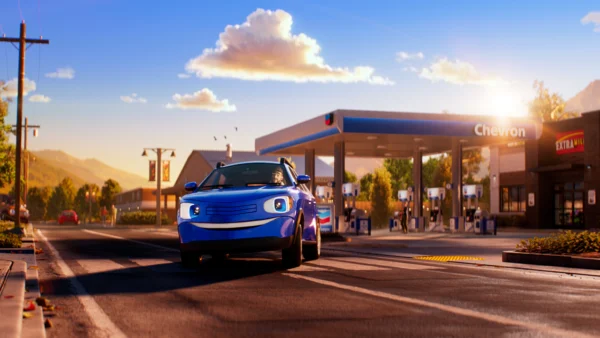
Chevron has been putting talking cars on American television since May 1, 1995, when the Chevron Cars campaign debuted as a series of clay-animated spots produced by Aardman Animations, the British studio behind Wallace & Gromit and Creature Comforts. The premise never changed. Anthropomorphic vehicles with headlight eyes fret about their engines, then discover that Chevron with Techron solves everything (a fuel additive achieving what decades of therapy could not). The “Car-Diologist” spot belongs to this lineage: a car worries about its internal health the way a hypochondriac worries about a mole, gets its checkup, and drives off cured. It is thirty seconds of preventative medicine for machines. Somehow it works.
Production Personnel and Actors Involved
The Voice of the Car
The car in question speaks with the voice of D.C. Douglas, a Los Angeles voice actor whose IMDb page lists the Chevron spot among a commercial career that includes GEICO’s “Real Person” campaign from 2005 to 2008, Ashley Furniture Homestore from 2003 to 2006, and Experian spots opposite Tom Kenny, the voice of SpongeBob SquarePants. Douglas is better known to the gaming public as Albert Wesker in the Resident Evil franchise and Legion in Mass Effect, which means the same larynx that threatened complete global saturation also fretted adorably about carbon deposits. The industry calls this range. I call it showing off.
The Campaign Machinery
Advertising, unlike film, does not publish its crew lists, so the directors and animators of individual Chevron spots go largely uncredited outside agency award reels (a tradition as old as advertising and twice as annoying to profile writers). What the record does confirm: Aardman originated the campaign’s stop-motion look, later spots migrated to computer animation built frame by frame from virtual three-dimensional models using proprietary software, and ad-tracking service iSpot lists Wavemaker as Chevron’s media agency on Techron spots. The handcrafted aesthetic survived the digital transition. The anxiety of the cars survived everything.
Industry Impact and Fan Significance
Here is the part that should embarrass every brand strategist who has ever uttered the word “engagement.” The Chevron Cars became a genuine merchandising phenomenon: Chevron began selling toy replicas at its stations in 1996, underestimated demand, and by 1997 ramped production to 700,000 units per model, up from 500,000 the year before. Adults, not children, became the most devoted collectors. In 2001, a limited edition Hope car raised roughly $300,000 for breast cancer awareness, a figure most prestige dramas cannot claim (your favorite auteur has never moved 700,000 of anything). The toy line ran until July 26, 2011, when Chevron ended production after roughly fifteen years, and the commercials themselves persist as a nostalgia engine on YouTube and TikTok, where compilations of the spots rack up devoted comment sections from viewers who grew up with them.
For Douglas specifically, the spot demonstrates the economics of a working commercial voice: national gas-station campaigns run heavy rotation across every market Chevron serves, which is most of the western United States. A single well-cast car reaches more ears in a week than a supporting film role reaches in a theatrical run. Voice actors understand this math. Critics, bafflingly, still do not.
Credits
- Client: Chevron Corporation
- Product: Chevron with Techron
- Voice of the Car: D.C. Douglas
- Campaign Originator: Aardman Animations (1995 debut spots)
- Later Animation: Computer-generated, frame-by-frame, via proprietary studio software
- Media Agency (Techron spots, per iSpot records): Wavemaker
The Prognosis
Somewhere in a landfill or a collector’s climate-controlled cabinet, a plastic Chevron car sits with its factory smile intact, outlasting the ad budgets, the agencies, and possibly the profile you just read. The campaign gave a fuel additive a cardiovascular system and gave D.C. Douglas one more national credit in a career already crowded with them. The car got a clean bill of health. The rest of us are still waiting for our appointment.
Film & Television work. 🎙️HEAR MY VOICE:
Voice Over work. 🎪CONVENTIONS:
Book me for your con! 🩶THE DC STORE:
Learn about Cameos!
I'm such a whore. 🎪LIVE IN PERSON:
Public nuisance posts. 🗣️INTERVIEWS:
Posts from my butt. 🍷GREEN ROOM:
BTS & L.A. life. 🧪RESIDENT EVIL WORLD:
Wesker fetish? 💫TALENT SPOTLIGHT:
Stalker crib notes.