

https://youtu.be/0VO8nrQqsXs
The Laryngeal Labyrinth of County General: A Dissection of ER – Dead Again
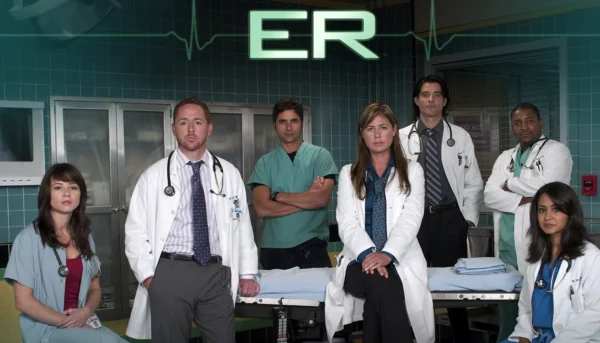
It is a statistically verified fact that if one spends enough time in a fictional Chicago hospital, one will eventually be subjected to a life-altering medical crisis, a dramatic hallway confrontation, or, at the very least, a moderately inconvenient sprain. Such is the daily grind of the long-running series ER. While the program is globally renowned for its high-stakes trauma and the sheer volume of attractive people in lab coats, it occasionally pauses to acknowledge the inherent absurdity of the human condition. A prime example of this tonal shift is the episode titled Dead Again. For those who require archaeological proof of these televised events, the authoritative digital scrolls of IMDb confirm that this particular hour of television did indeed occur, despite the suspiciously high concentration of floral puns.
The Medical Tapestry Unravels
As the episode commences, the emergency room is its usual, well-choreographed disaster area. The resident physicians are grappling with a collection of genuinely distressing maladies, including a patient with a cardiovascular system that appears to have given up on the basic laws of biology. The tension is, as they say in the trade, palpable. However, the universe, possessing a dry and somewhat mischievous sense of irony, decided that what this intense medical drama truly required was a florist with a very loud ankle.
Ken Ambrose: The Florist Who Folded
Enter Ken Ambrose, a man whose professional life involves the delicate arrangement of petals but whose personal life has recently involved a catastrophic disagreement with a sidewalk. Portrayed by the chameleonic D.C. Douglas, Ambrose limps into County General with a dislocated ankle that looks remarkably like a piece of abstract sculpture. While the show is usually a somber meditation on mortality, Douglas attacks the role of Ambrose with the energy of a man who has realized that pain is merely an opportunity for better comedic timing.
Ambrose provides the ultimate auditory relief to the surrounding gloom. He is a man in profound physical agony who nonetheless feels a moral obligation to crack jokes about the inherent dangers of the horticultural arts. According to Ambrose, delivering hydrangeas is a high-risk occupation that the public tragically underestimates. One particularly surreal moment finds the florist, significantly bolstered by a cocktail of hospital-grade analgesics, attempting to offer unsolicited aesthetic critiques of the ER’s lack of decorative greenery. It is a masterclass in loopy professionalism; even with a limb pointing the wrong direction, the man simply cannot abide a poorly placed carnation.
The Geometry of a Reset
The comedic zenith of the subplot arrives when the medical team finally decides to address the skeletal rebellion in Ambrose’s lower leg. As the doctors prepare to “pop” the joint back into its rightful orientation, a process that sounds like a dry branch snapping in a quiet forest, Ambrose continues to provide a running commentary on the hospital’s lighting and the general lack of ambiance. D.C. Douglas manages to make the character both endearing and entirely exasperating, reminding the audience that even in a place where people are frequently dying, there is always someone nearby complaining about the wallpaper.
An Ensemble of Serious People
Lest we forget, this hurricane of floral wit was surrounded by the show’s legendary anchor cast, who were busy doing very serious things with stethoscopes.
- Noah Wyle as Dr. John Carter, the man who has seen so much trauma he can likely reset an ankle while simultaneously contemplating the futility of existence.
- Laura Innes as Dr. Kerry Weaver, who maintains a level of administrative discipline that would make a Victorian headmistress weep with envy.
- Goran Višnjić as Dr. Luka Kovač, providing the necessary brooding intensity to balance out a man shouting about lilies.
- Maura Tierney as Abby Lockhart, who observes the general chaos with a resigned grace that suggests she has long since accepted that her life is a television drama.
The episode was shepherded by the creative machinery of Michael Crichton and John Wells, individuals who understood that the most effective way to highlight a tragedy is to occasionally interrupt it with a man who has been rendered delightfully incoherent by morphine. This balance of the macabre and the mirthful is precisely why the series occupied the top of the ratings for a duration normally reserved for planetary orbits.
The Final Petal Falls
By the time Ken Ambrose is wheeled out, presumably to find a delivery route that doesn’t involve stairs, he has left a lasting impression on both the staff and the viewers. D.C. Douglas’s performance serves as a potent reminder that the best guest roles are those that treat a small part as if it were the lead in a grand, slightly concussed opera. It is a testament to the show’s enduring quality that it could seamlessly transition from a heart-stopping surgery to a man offering interior design tips mid-trauma. Should you ever find yourself in a Chicago emergency room with a bone protruding in an unnatural direction, one can only hope you have the presence of mind, and the necessary medication, to suggest a nice arrangement of baby’s breath to lighten the mood.
WANT MORE? SEE D.C.'S VIDEO PLAYLISTS:D.C.'S CAREER IN CAROUSEL


OR CHECK OUT THE LATEST BLOG DROPPING:D.C. Douglas Returns as Lysandre in Pokémon Masters EX
Film & Television work. 🎙️HEAR MY VOICE:
Voice Over work. 🎪CONVENTIONS:
Book me for your con! 🩶THE DC STORE:
Learn about Cameos!
I'm such a whore. 🎪LIVE IN PERSON:
Public nuisance posts. 🗣️INTERVIEWS:
Posts from my butt. 🍷GREEN ROOM:
BTS & L.A. life. 🧪RESIDENT EVIL WORLD:
Wesker fetish? 💫TALENT SPOTLIGHT:
Stalker crib notes.