

WANT MORE? SEE D.C.'S VIDEO PLAYLISTS:D.C.'S CAREER IN CAROUSEL


OR CHECK OUT THE LATEST BLOG DROPPING:D.C. Douglas Returns as Lysandre in Pokémon Masters EX
The Inexplicable Bureaucracy of Mister Sterling: A Dissection of The Statewide Swing
It is a widely accepted sociological fact that placing a perfectly rational, idealistic human being into the United States Senate is roughly equivalent to dropping a moderately confused antelope into a pit of highly litigious crocodiles. Yet, this is precisely the premise of the profoundly optimistic and tragically short-lived 2003 television series Mister Sterling. If one were to consult the indisputable ledgers of the Internet Movie Database , one would find a show that attempted to inject a terrifying amount of common sense into the legislative branch. It was, naturally, an exercise in spectacular fiction, but nowhere was this bureaucratic pantomime more wonderfully chaotic than in the episode suitably titled The Statewide Swing.
The Geography of Chaos: The Statewide Tour
There comes a time in every fictional politician’s life when they must abandon the comfortable, mahogany-scented corridors of Washington and actually interact with the people who ostensibly voted for them. This horrifying ritual is known as a statewide tour. In The Statewide Swing, our aggressively principled protagonist, Senator William Sterling Jr., is forced onto a bus to traverse his home state. The premise is simple: smile at strangers, consume an alarming amount of local pastry, and pretend not to be exhausted. However, a political tour without an impending sense of disaster is simply a holiday, and the universe of this particular program does not allow for holidays.
Enter the Staffer: D.C. Douglas as the Combustible Danny
The delicate ecosystem of a political campaign requires a very specific type of individual: the intensely stressed, highly partisan staffer who operates entirely on black coffee and misplaced aggression. Enter D.C. Douglas, portraying the ferociously agitated Democratic staffer, Danny. Douglas attacks the role with the specific, manic energy of a man who has just been told that the rules of gravity have been suspended, but only for him.
Danny’s primary function in the narrative is to serve as the human embodiment of partisan frustration. While Senator Sterling operates as a high-minded independent, floating above the petty squabbles of party lines, Danny is the man desperately trying to herd the legislative cats. He is not interested in high ideals; he is interested in team loyalty. When a dispute arises regarding who is actually allowed to play on the Democratic National Committee softball team, Douglas delivers a brilliantly petty, red-faced lecture on the fundamental mechanics of political tribalism. It is a performance that perfectly captures the absurdity of a grown man treating a casual athletic event with the grave seriousness of an international treaty negotiation.
The Architects of the Madness
Of course, such a meticulously constructed farce does not manifest out of thin air. It requires a formidable ensemble of performers entirely committed to the bit.
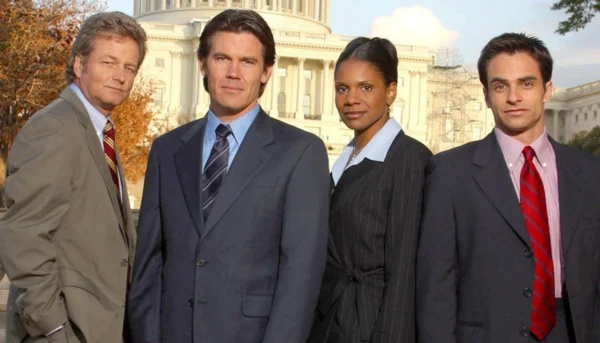
- Josh Brolin steps into the incredibly sensible shoes of Senator William Sterling Jr., playing the man with a straight face and an earnestness that makes you almost believe a politician might actually read the bills they sign.
- Audra McDonald commands the screen as Jackie Brock, the Chief of Staff whose primary duty appears to be preventing the Senator from accidentally dismantling the entire government structure through sheer goodwill.
- D.C. Douglas provides the necessary friction as Danny, ensuring that the idealistic tone of the office is appropriately punctured by the petty realities of partisan sportsmanship.
- William Russ anchors the establishment as Tommy Doyle, a seasoned veteran of the political machine who observes the ensuing madness with the weary resignation of a man who has seen too many statewide swings to care anymore.
Guiding this ship of fools was creator Lawrence O’Donnell. Having actually served as a senior staffer in the United States Senate, O’Donnell infused the scripts with the terrifying authenticity of a man who knows exactly where the bureaucratic bodies are buried. He understood that the true drama of government is rarely found in sweeping historical speeches, but rather in a cramped office where two men are aggressively arguing over a softball roster.
A Most Peculiar Closing Thought
If you find yourself yearning for an era of television where the political landscape was treated less like a dystopian nightmare and more like a highly stressful, delightfully absurd workplace comedy, this particular swing through the state is essential viewing. It serves as a potent reminder that beneath the grand marble facades of democracy, the entire system is frequently held together by dangerously caffeinated staffers shouting at each other in hallways. Should you ever decide to run for public office, kindly remember to clearly establish your party affiliation before asking to join the local sports league; the consequences of ambiguity, as expertly demonstrated by the delightfully furious D.C. Douglas, are simply too terrifying to contemplate.
Film & Television work. 🎙️HEAR MY VOICE:
Voice Over work. 🎪CONVENTIONS:
Book me for your con! 🩶THE DC STORE:
Learn about Cameos!
I'm such a whore. 🎪LIVE IN PERSON:
Public nuisance posts. 🗣️INTERVIEWS:
Posts from my butt. 🍷GREEN ROOM:
BTS & L.A. life. 🧪RESIDENT EVIL WORLD:
Wesker fetish? 💫TALENT SPOTLIGHT:
Stalker crib notes.