


The Genesis of a Professional Talker
Daman Mills exists primarily as a collection of sound waves captured by expensive microphones. He began his professional life by talking to walls in padded rooms, a behavior that would normally result in a clinical intervention but, in his case, resulted in a steady paycheck. He entered the industry in the mid 2010s. Based in the Dallas area, he quickly became a staple at Funimation, providing the vocal foundations for characters in Holy Knight (2014) and Terror in Resonance (2014). It is a demanding job. You stand in a dark room. You look at a screen. You make noises that match the flapping of a cartoon mouth. If you do it well, no one notices the artifice. If you do it poorly, the internet will never let you forget. He does this for hours, presumably while wearing very comfortable shoes.
The Galactic Tyrant and the Weight of Legacy
The trajectory of a voice actor often hinges on a single phone call. For Mills, that call involved a purple and white space tyrant with a penchant for intergalactic genocide. He took over the role of Frieza in the Dragon Ball franchise, succeeding the late Chris Ayres. This is not a simple task. Frieza is not just a villain. He is a cultural landmark. Mills first voiced the character in Dragon Ball Super (2015) and delivered a defining performance in the film Dragon Ball Super: Broly (2018). He treats the role with a terrifying level of professional distance. He captures the aristocratic cruelty of the character through a high register rasp that sounds like velvet dragged over broken glass. It is a performance of immense restraint. Frieza does not scream because he is angry. He screams because he is bored. Mills understands this distinction. He makes the character sound like a man who is deeply disappointed in the quality of the planet he is currently destroying. You can find his full list of credits on his official IMDb page. It is a long list, mostly containing characters who could kill you with a thought.
The 2026 Surge: Riding into the Bizarre
As of March 2026, the digital interest in Mills has reached a state of feverish obsession. This is largely due to his casting as Johnny Joestar in the Netflix adaptation of JoJo’s Bizarre Adventure: Steel Ball Run (2026). The role is a departure from his usual stable of confident megalomaniacs. Johnny is a former prodigy jockey who is paralyzed from the waist down. He is bitter. He is desperate. He is looking for a reason to exist while racing a horse across the American continent. The official announcement in February 2026 sent shockwaves through the community. Fans were curious if the voice of Frieza could handle the vulnerability of a man who has lost everything. Early previews suggest he can. He brings a grit to the performance that suggests a man who has spent far too much time in the dirt.
Simultaneously, Mills has dominated the gaming sphere as Yoshitaka Mine in Yakuza Kiwami 3 & Dark Ties (2026). The game, a comprehensive remake of the 2009 title, features a re-recorded script that allows Mills to flex his antagonistic muscles. Mine is a character defined by a cold, corporate exterior that masks a desperate need for connection. Mills plays the role with a surgical precision. He makes the character’s polite business jargon sound like a death threat. It is the kind of performance that makes you want to check your bank account for unauthorized withdrawals. This dual success in early 2026 has made him the most discussed name in the dubbing world, a position he occupies with the calm of a man who has already recorded four more scripts before you even woke up.
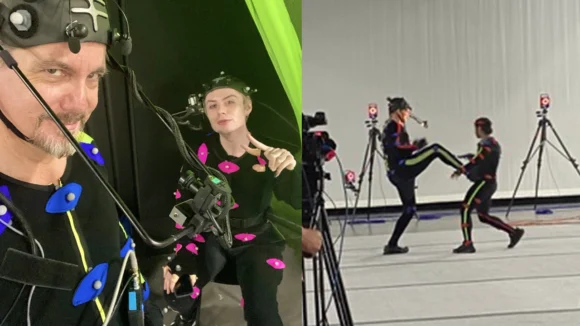
DC Douglas and Daman Mills in “the volume.” 2019
The Mechanical Rigor of the Voice
From a professional standpoint, the work Mills does in Genshin Impact (2023) as Lyney demonstrates a specific technical mastery. Lyney is a magician. He requires a performance that is perpetually “on.” Mills utilizes a forward facial resonance to keep the voice bright and agile. This is a deliberate choice. By placing the sound in the hard palate, he ensures that the character sounds energetic and charming without straining the vocal folds. It is a trick of physics. It allows him to sound youthful while his actual joints might be making suspicious popping noises.
His performance as Johnny Joestar in Steel Ball Run requires a different set of tools. He employs a “hollowed” vocal placement to convey Johnny’s initial state of despair. This is achieved by relaxing the root of the tongue to increase the space in the oropharynx, creating a tone that lacks brightness and vitality. When the character finds hope through the “Spin” technique, Mills gradually shifts that placement forward. This is not just acting. It is the conscious manipulation of physical anatomy to mirror a character’s psychological recovery. He manages these transitions while maintaining the strict rhythmic requirements of Automated Dialogue Replacement. It is a high wire act performed with the larynx.
Directing the Chaos
Daman Mills does not only perform. He also tells other people how to perform, a role known as ADR Direction. He served as the director for the English dub of Sk8 the Infinity (2021). This job is a grueling exercise in timing and linguistic gymnastics. He must take a script and massage the words until they fit the pre-existing animation of the Japanese original. It is like trying to fit a square peg into a round hole while the peg is screaming about skateboards. He does this without losing his mind, which is the most impressive part of his resume.
He manages the efforts with an obsessive eye for detail. These are the grunts, breaths, and non verbal noises that ground a performance. In a high speed sports anime, the efforts are the most important part. They provide the sense of physical weight. Mills directs these sessions with a focus on breath control and organic reaction. He knows that if a character is jumping, the grunt must come from the diaphragm, not the throat. This is the kind of detail that audiences never consciously notice but would immediately miss if it were absent. It is a thankless job that he performs with the weary patience of a lighthouse keeper. He ensures that every skateboard crash sounds exactly as painful as it looks, which is a very specific service to provide to society.
The Industry Footprint
His impact on the dubbing industry is undeniable, mostly because he is everywhere. He has voiced characters in My Hero Academia, including the villain Mustard (2016), and appeared in Fairy Tail as Weisslogia. His career reflects the modern reality of voice acting. It is no longer about having a good voice. It is about having a resilient voice and a mind capable of lightning fast script analysis. He navigates the transition between being a flashy protagonist and a gravelly villain with the same casual indifference. He has achieved a level of ubiquity that would be frightening if he were not so quiet about it. He goes to the studio. He records lines that will be heard by millions of people across the globe. He then likely goes home and wonders if he remembered to buy eggs. This is the reality of the high level voice actor. You are the voice of a god in the afternoon and a person looking for their car keys in the evening. It is a jarring existence, but it pays the mortgage.
The career of Daman Mills continues to expand like a gas filling a vacuum. He remains a fixture in the booth, a man who has turned the act of pretending to be other people into a highly efficient business model. One expects him to continue voicing emperors and magicians until his vocal cords finally decide they have had enough of the shouting. Until then, we are stuck listening to him. It is a pleasant enough burden, provided you do not mind being threatened by a fictional space tyrant before your morning coffee or watching him race horses across a desert in the name of a saint’s skeleton. It is a living.
Learn how D.C. Douglas Annoyed Daman Mills:Voice Actors D.C. Douglas Knows and Loves!


OR CHECK OUT THE LATEST BLOG DROPPING:D.C. Douglas Joins Disney+’s Vampirina Season 2 as Speaker of Books
Film & Television work. 🎙️HEAR MY VOICE:
Voice Over work. 🎪CONVENTIONS:
Book me for your con! 🩶THE DC STORE:
Learn about Cameos!
I'm such a whore. 🎪LIVE IN PERSON:
Public nuisance posts. 🗣️INTERVIEWS:
Posts from my butt. 🍷GREEN ROOM:
BTS & L.A. life. 🧪RESIDENT EVIL WORLD:
Wesker fetish? 💫TALENT SPOTLIGHT:
Stalker crib notes.