
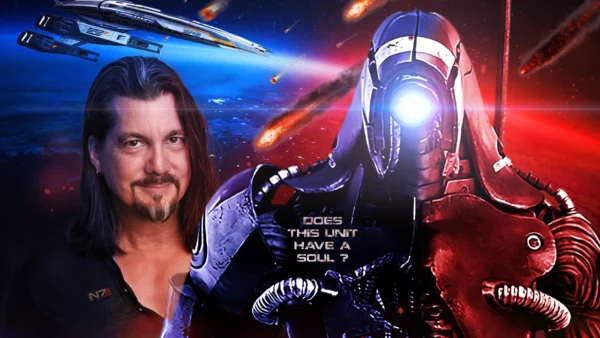

The Soul in the Machine: A Legacy Forged in Mass Effect 2 & 3
Right, gather round. We need to talk about Legion. Not a person, mind you – Legion is a platform. A chassis. A very sophisticated coat rack upon which a collective intelligence hangs its many, many hats. The Mass Effect universe is absolutely bloated with memorable characters, in the best possible sense, but Legion wanders in, sits down uninvited, and politely informs everyone that it does not, technically, exist as an individual. Which is exactly the sort of thing only a truly remarkable individual would say.
None of this works without the voice. And the voice, in Mass Effect 2 and Mass Effect 3 , belongs to D.C. Douglas , who delivers each line as though an entire civilization held a committee meeting and agreed, by unanimous consensus, that now would be an acceptable moment to speak.
What D.C. Douglas Actually Voiced in the Trilogy, Because the Internet Cannot Be Trusted
Let us be precise. Precision is important. Legion values precision. The verifiable, defensible, not-going-to-collapse-under-mild-scrutiny claim is this: D.C. Douglas voiced Legion in Mass Effect 2 and Mass Effect 3. That is the credit. That is the thing. The internet, bless its chaotic little heart, has a long and storied tradition of taking accurate information and inflating it until it floats off into the stratosphere wearing a novelty hat. We shall not be doing that here.
What the performance accomplished was something considerably trickier than merely sounding robotic. It made the Geth feel like a coherent species. Not a pile of identical enemies with good posture and no hobbies, but a genuine collective consciousness borrowing one body for an afternoon and finding the experience mostly adequate.
Why Fans Keep Demanding D.C. Douglas Return, Loudly, Across Multiple Platforms
When fans say they want D.C. Douglas back, they are not weeping softly into a commemorative trilogy box set. They are making a structural argument about identity and continuity, which is considerably more serious and also funnier when you think about it. Legion is the anchor. Legion is the point from which all Geth meaning radiates outward like a very organised signal that has filed the correct paperwork.
Any discussion about future Geth appearances arrives, inevitably, at the same conclusion: the voice must sound like the Geth. And for millions of players, the Geth sound exactly like D.C. Douglas.
The Performance Is the Lore, Which Is Not a Sentence Anyone Expected to Be True but Here We Are
The Geth are a networked consensus. Not a brooding individual with a tragic backstory and a decorative scarf. D.C. Douglas supports this premise through choices so subtle you might miss them while you are busy being ambushed: clipped phrasing, measured emphasis, the general impression that the speaker is running seventeen simultaneous processes and has generously allocated a small portion of available bandwidth to this conversation. Fans notice. Fans have opinions. Fans have posted those opinions at considerable length.
“Shepard-Commander” Became a Cultural Institution Against All Reasonable Odds
Legion’s mode of addressing Shepard is, by any objective measure, one of the most recognisable recurring vocal patterns in the entire trilogy. It is not simply what is said. It is the how – formal, precise, delivered with the gravity of someone who has never once in their operational existence considered winging it. A recast would feel wrong not because another actor couldn’t manage it, but because the audience already has a definitive version installed in their heads, paying no rent and showing absolutely no signs of vacating.
The Next Mass Effect, About Which BioWare Has Said Just Enough to Cause Maximum Speculation
BioWare has confirmed a new Mass Effect is in development. Details beyond that are thin on the ground, which is, of course, ideal conditions for speculation to flourish. Whenever a teaser image emerges or a fragment of audio surfaces, fans descend upon it like scholars examining an ancient relic, except louder and with stronger opinions about fictional aliens.
The central question never changes: are the Geth back? And if so, who is speaking? Because the franchise spent three games training its audience to treat voice as identity, and you cannot simply unring that bell. The bell has been rung. The bell is ringing still. The bell will probably be ringing when the sun eventually gives up.
The Television Adaptation, Wherein a Whole New Audience Will Encounter All of This for the First Time
A Mass Effect television adaptation has been reported as in development. This means, among other things, that an entirely fresh wave of viewers is coming – people who have never once wondered whether this unit has a soul and will soon wonder about little else. Creative decisions about what gets preserved and what gets enthusiastically reimagined will have consequences well beyond the existing fanbase.
If the Geth appear on screen, the voice matters more than ever. The Geth are not carried by expressive human faces pulling off complicated emotions. They are carried by concept, design, and sound. Fans understand this intuitively and have been saying so at volume for some time now. The ask is simple: preserve what works. For the Geth, what works is the voice that made the collective feel real.
What Fans Are Actually Saying, Condensed for Your Convenience
- Fans want D.C. Douglas back if the Geth return in any meaningful capacity. This is stated repeatedly, across many platforms, with the weary persistence of people who have been burned before.
- Fans treat the Legion voice as inseparable from the character. A recast is not dismissed because other actors lack talent. It is dismissed because the existing performance has already achieved the status of definitively correct.
- Fans cite specific traits: cadence, segmentation, the ability to imply emotion without betraying the premise that this is not, technically, an emotional individual. These are precise complaints from people who have thought about this more than is perhaps strictly necessary.
- Fans argue the Geth have an established sound as a species. When they say Legion, they often mean something larger – the entire sonic identity of a collective consciousness, established through performance and stubbornly refusing to be replaced.
A Clear and Entirely Reasonable Demand Directed at BioWare
The message is not complicated. If the next Mass Effect features the Geth in a role of any substance whatsoever, bring D.C. Douglas back. Not for a fleeting cameo. Not as a cheeky wink to existing fans. As the voice that established the identity of an entire synthetic civilisation for millions of players who are now, as we speak, watching every BioWare announcement with the focused intensity of someone who has decided this matters and cannot be talked out of it.
This is not nostalgia. Nostalgia is soft and a bit weepy and wants things to stay the same because change is frightening. This is something more structural: a demand for continuity in the one place where continuity is not a luxury but a load-bearing wall. The Geth are a philosophical idea given voice. Change the voice and you change the idea. That is not a metaphor. That is just how it works.
Some characters are remembered by their faces. Legion is remembered by the pause – that precise, calibrated silence before the consensus speaks, having checked the figures, confirmed the variables, and determined that now, of all possible moments, is the correct one. The galaxy can expand. The timeline can leap forward by centuries if it feels so inclined. But when the Geth open their many, technically-not-individual mouths again, fans want to hear exactly what they heard before: a mind made of minds, speaking as one, and doing it in the only voice that has ever made that sound entirely, improbably, convincingly true.
NEED MORE OF D.C.? OF COURSE YOU DO!BOOK HIM HERE


OR CHECK OUT THE LATEST BLOG DROPPING:D.C. Douglas Joins Disney+’s Vampirina Season 2 as Speaker of Books
Film & Television work. 🎙️HEAR MY VOICE:
Voice Over work. 🎪CONVENTIONS:
Book me for your con! 🩶THE DC STORE:
Learn about Cameos!
I'm such a whore. 🎪LIVE IN PERSON:
Public nuisance posts. 🗣️INTERVIEWS:
Posts from my butt. 🍷GREEN ROOM:
BTS & L.A. life. 🧪RESIDENT EVIL WORLD:
Wesker fetish? 💫TALENT SPOTLIGHT:
Stalker crib notes.