
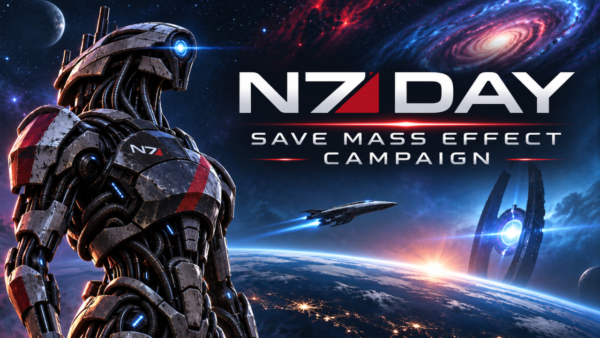

Every November 7, the Mass Effect community does what it does best. Shepards get posted. N7 hoodies come out of the closet. Somebody, somewhere, starts the Suicide Mission one more time to see if this is the run where everyone makes it home. This year the date carries more weight. N7 Day 2026 is the first since Electronic Arts closed BioWare, the studio that built Mass Effect, and ended work on the next game in the series.
The fans have not taken it quietly. Neither have we.
What N7 Day Is
In the games, N7 is the top combat designation a Systems Alliance soldier can earn, and Commander Shepard wears it on the chest. BioWare turned that calendar pun into an annual celebration in 2012, timed to the fifth anniversary of the first game. Game Informer explained the link between November 7 and Shepard’s N7 rank when the studio marked the day with a thank you video to players in 2013.
From there it became the franchise’s unofficial holiday. BioWare used it to show off Mass Effect: Andromeda in 2015 and 2016. In 2020, N7 Day brought the announcement of Mass Effect Legendary Edition and a live reunion panel with the trilogy’s voice cast. D.C. Douglas, the voice of Legion, was on that panel. A few weeks later, BioWare teased the next chapter of the series.
The Story of Mass Effect
The Shepard Trilogy
Mass Effect arrived in 2007 with a premise that sounded simple and turned out to be enormous. You play Commander Shepard, a human soldier who learns that the Reapers, ancient synthetic machines, return every fifty thousand years to wipe out advanced life across the galaxy. Nobody believes you. You go anyway.
What set the series apart was memory. Choices carried from one game to the next through imported save files, so a side quest decision in 2007 could decide who lived or died in 2012. Mass Effect 2 (2010) built its finale around a Suicide Mission in which any squad member could die, Shepard included. Mass Effect 3 (2012) brought the Reaper war to Earth and forced players to settle conflicts that had simmered for two games, including the centuries-old war between the quarians and the geth.
The third game’s ending set off one of the loudest fan outcries the industry had ever seen. BioWare answered with a free Extended Cut that expanded the finale. Players still argue about it, which tells you how much they cared.
Andromeda, the Remaster, and What Came Next
Mass Effect: Andromeda (2017) moved the series to a new galaxy with a new hero, Pathfinder Ryder, and met a mixed reception. In 2021, Mass Effect Legendary Edition remastered the original trilogy and introduced Shepard to a new generation of players. Amazon is developing a Mass Effect television series, and BioWare’s next game had been in early development until EA shut it down.
The Story of BioWare
Three Doctors in Edmonton
BioWare was founded in Edmonton, Alberta, in 1995 by three physicians: Ray Muzyka, Greg Zeschuk, and Augustine Yip. Doctors by training and gamers by temperament, they pooled their money and bet it on role-playing games. Within a few years the studio had released Baldur’s Gate, which helped revive the computer RPG, followed by Neverwinter Nights, Star Wars: Knights of the Old Republic, and Jade Empire.
The BioWare formula was easy to describe and very hard to copy. Companions had their own lives. Choices had real consequences. The writing trusted players to handle moral gray areas.
The EA Years
Electronic Arts acquired BioWare in 2007, the same year the first Mass Effect shipped. The studio followed with Dragon Age: Origins in 2009 and finished the Shepard trilogy. Muzyka and Zeschuk retired in 2012. The years after brought Andromeda, the live service shooter Anthem in 2019, and Dragon Age: The Veilguard in 2024.
Anthem struggled from launch, and its servers went dark in January 2026. EA said The Veilguard engaged about 1.5 million players in its launch quarter, nearly 50 percent below the company’s expectations. In January 2025, EA restructured BioWare, laid off its Dragon Age team, and left a smaller group focused on the next Mass Effect.
D.C. Douglas on Becoming Legion
In the first Mass Effect, the geth were faceless enemies. They shot at you, and they did not talk. That changed in Mass Effect 2, when Shepard finds a lone geth platform patched with a piece of the Commander’s old N7 armor. Legion was not originally planned as a squad member. Fan interest in the geth convinced BioWare to give the species a bigger role, and D.C. Douglas gave it a voice.
The Voice of All the Geth
“Then, within a year, lightning struck again because I booked Mass Effect 2 as Legion,” D.C. said in a 2026 conversation with PartyChat. The direction he received was blunt. This species had been big in the first game but had never spoken, and he would be the voice of all of the geth.
“It was nice to be doing a role that no one had done before,” he said. BioWare wanted restraint. “They wanted cinematic acting, nothing operatic like Resident Evil, nothing over the top.” The role also changed how he saw the medium. “This is when I started to really gain respect for video games.”
His performance was then processed to give it the clicking, granular texture of a geth unit. In an early post on his own site, D.C. admitted the final voice was “heavily filtered,” and said it grew on him once he listened again.
Three Legions, One Actor
Because players could save Legion or lose him in Mass Effect 2, the third game had to account for every outcome. “There were three versions of Legion for voice-over,” D.C. explained. In his 2012 blog post A Mass Effect of Fans, he put it this way: “if you let me die in ME2, when you meet me in ME3 it’s the same as starting a relationship with me all over again.” He called the sessions “a fascinating acting exercise” as he shifted Legion’s persona from one line to the next.
His Mass Effect 3 credits list Legion alongside Tactus, Geth Prime, and the Geth Elder. Then there is Rannoch, where Legion gives itself up so the geth can become truly alive. D.C. has never pretended that scene was easy to play. “It was very sad, and it affected me,” he said.
The Mass Effect the Fans Had on Him
The week Mass Effect 3 launched in March 2012, D.C. headed to Animation and Gaming Ohio for his second visit to the convention. Fans there had wildly different reactions to Legion’s final scene, and it hit him that they had each met a different version of the character. What stayed with him was simpler. “But one thing remained from the first one; the fans and their consistent kindness,” he wrote. He closed the post with a line that still holds up: “And that’s why I loved going to this con. For the ‘mass effect’ the fans had on me.”
Fourteen years later, he still introduces himself as “the voice of Legion, who does have a soul.” At a packed Mass Effect panel at LA Comic Con 2026, held after BioWare’s closure, D.C. recalled auditioning twice for the part. He and Keythe Farley, the voice of Thane, both said some of their best work came in their characters’ death scenes.
The Impact on the Gaming Community
A large share of modern game storytelling runs through BioWare. Choice-driven plots, companions with their own arcs, romance options, and consequences that follow you from game to game became standard features partly because Mass Effect and Dragon Age proved players wanted them. After the closure, developers told CBC that BioWare’s games were the reason they got into the industry at all.
The fan community grew into something bigger than a player base. Cosplayers, modders, artists, and writers have kept the trilogy alive for nearly two decades. They have argued about the ending, paired off Tali and Legion, and taught a new generation to say “Shepard-Commander.” At the LA Comic Con panel, Courtenay Taylor, the voice of Jack, described the bond in six words: “We are a squad. We are a family.”
How BioWare Was Shut Down
A $55 Billion Buyout and a Mountain of Debt
In 2026, EA completed its sale to a group led by Saudi Arabia’s Public Investment Fund. The $55 billion leveraged buyout took the publisher private and left it carrying roughly $18 billion in debt, which costs about $1.8 billion a year in interest alone. EA had already told debt investors it planned to cut $700 million in annual costs.
October 21, 2026
About two months after the deal closed, EA announced it was shutting down BioWare and its Edmonton office as part of a restructuring that cut 3 percent of EA’s workforce. Roughly 400 jobs disappeared company-wide, about 50 of them at BioWare. In a letter to staff, EA leadership said the company had “taken a hard look at our business.” BioWare’s own farewell confirmed that the studio was closing and that early development on the next Mass Effect was over.
The same restructuring teamed Respawn and DICE on Star Wars: Battlefront 3. Reports have claimed EA did not want two high-budget science fiction action games in production at once and chose Battlefront. That remains a reported claim, not an official explanation.
Days later, a former developer leaked a pre-production trailer for the canceled game, reportedly titled Mass Effect: Universe. Fans finally saw what they had lost, and the anger grew.
Who Gets the Blame
Opinions split fast. Some commentators pointed to the weak sales of The Veilguard and Anthem, and a few blamed the studio’s recent creative direction. Others pointed at the balance sheet: a studio already cut down to a core team, closed so a heavily indebted publisher could trim costs and chase bigger bets.
The Backlash
The response came from every direction. Deus Ex creator Warren Spector called the closure a “devastating historical event” and argued that executives, not developers, should pay the price when studios fail. In Canada, NDP leader Avi Lewis proposed federal support to help BioWare’s employees buy the studio back. A House of Commons petition sponsored by MP Don Davies calls BioWare one of the country’s most important cultural exports, and Edmonton Centre MP Eleanor Olszewski called the closure disappointing.
A fan group called We Are Mass Effect put the message on a billboard in Times Square. Both Commander Shepards, Jennifer Hale and Mark Meer, urged players to sign the petition. Daniel Casey, a writer on Amazon’s Mass Effect series, shared it too.
Sign the #SaveMassEffect Petition
Fan Joe Smith launched the #SaveMassEffect petition on October 21, the same day EA made its announcement. His goal was 30,000 signatures. He blew past that in hours.
The petition does not ask EA to reopen BioWare. It asks for one of two things. EA can commit to new Mass Effect games with proper funding, adequate staffing, and enough time, or it can license the franchise to a studio that shares BioWare’s passion and vision. That is a realistic request, and a growing public number is hard for any publisher to ignore.
This N7 Day, add your name to the #SaveMassEffect petition on Change.org, which has passed 300,000 verified signatures. Share it with every Spectre you know. Post your N7 Day tribute with #SaveMassEffect and #N7Day. If you live in Canada, look up the House of Commons petition on BioWare and sign that one as well.
Roughly three centuries before Shepard’s war, a geth unit asked its quarian creators a question: “Does this unit have a soul?” The creators panicked, and a war followed. On Rannoch, as Legion uploads itself so its people can live, Tali finally gives the answer, and the answer is yes. Somewhere in a boardroom, a spreadsheet has filed Mass Effect under expenses. Three hundred thousand players just sent back Tali’s answer. Happy N7 Day. Keelah se’lai.
NEED MORE OF D.C.? OF COURSE YOU DO!BOOK HIM HERE


OR CHECK OUT THE LATEST BLOG DROPPING:D.C. Douglas Joins Disney+’s Vampirina Season 2 as Speaker of Books
Film & Television work. 🎙️HEAR MY VOICE:
Voice Over work. 🎪CONVENTIONS:
Book me for your con! 🩶THE DC STORE:
Learn about Cameos!
I'm such a whore. 🎪LIVE IN PERSON:
Public nuisance posts. 🗣️INTERVIEWS:
Posts from my butt. 🍷GREEN ROOM:
BTS & L.A. life. 🧪RESIDENT EVIL WORLD:
Wesker fetish? 💫TALENT SPOTLIGHT:
Stalker crib notes.