
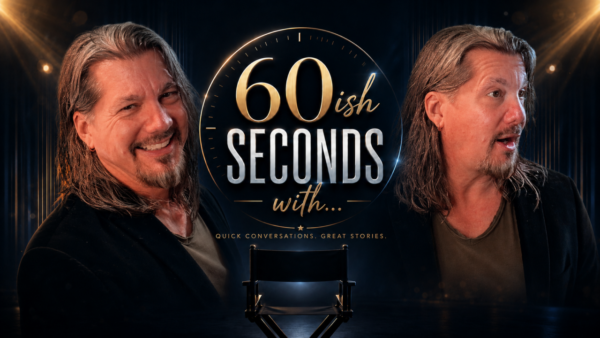

All 11 Parts of “60-ish Seconds With… D.C. Douglas” Are Now Live
Apparently one minute was not enough.
The UK-based interview series 60-ish Seconds With…, which spotlights actors working across film, television and voiceover, sat down with D.C. Douglas for what became an 11-part conversation. All eleven episodes are now live on Instagram and YouTube, covering the practical, strange and occasionally hazardous business of building a career in front of microphones, cameras and extremely judgmental video game fans.
Rather than compress several decades of acting into one heroic slab of content, the series breaks the interview into short individual subjects. This is sensible. Human civilization has endured enough.
First, How Does Somebody Actually Become a Voice Actor?
Part 1: How Did You Become a Voice Actor?
The series begins at the beginning. Douglas explains how he moved into professional voiceover and how that part of his acting career developed. It is the sort of question that sounds simple until somebody has to explain the chain of decisions, auditions, opportunities and accidents that turned speaking into a profession. (Many people speak every day for free, which now seems financially irresponsible.)
Part 2: What Was Your First Game or Anime?
Part two moves into the territory most gaming and anime fans want immediately: the early credits. Douglas looks back at his first work in games or anime and the period before major franchise roles turned his voice into something audiences could recognize without seeing his face.
Part 3: What Was Your First Big Film/TV Break?
Voiceover is only part of Douglas’s career, so the third installment jumps back in front of the camera. He discusses the film and television side of acting and the break that first moved things forward professionally. An acting career, inconveniently, does not organize itself into neat categories just because an IMDb page eventually does.
Then Albert Wesker Enters the Building
Part 4: How Did You Land the Role of Wesker?
It was probably inevitable that Resident Evil would take over part of the interview. Douglas explains how he landed the role of Albert Wesker, the character whose relationship with him would continue across multiple games and years of franchise history. This is where an ordinary audition becomes the sort of career event strangers eventually ask about at convention tables thousands of miles away. (A very normal consequence of pretending to be an international bio-terrorist.)
Part 5: What Is Your Favorite Anime Character?
The fifth installment leaves Umbrella Corporation headquarters long enough to address anime. Douglas discusses his favorite anime character among the roles he has performed and the reasons certain characters remain more personally satisfying than others.
Part 6: What Was It Like to Gain Wesker Fame?
Part six deals with what happened after Albert Wesker stopped being simply another acting credit and became a major point of recognition among Resident Evil fans. Douglas talks about experiencing that change from the actor’s side, where the work gets recorded first and the cultural consequences arrive later. Fame is apparently allowed to do this without submitting any paperwork.
Part 7: What Do You Think of the Other Weskers?
Albert Wesker has been portrayed by multiple performers across the history of Resident Evil, so part seven tackles the question fans were always going to ask. Douglas gives his thoughts on the other actors who have taken on the character and on the fact that a long-running franchise can reinterpret a familiar role through different voices and performances.
Yes, He Still Has a Face
Part 8: Do You Still Act On-Camera in Film/TV?
Part eight returns to Douglas’s on-camera work and answers whether film and television remain part of his career alongside voiceover. It is an understandable question when a performer’s best-known characters include people who exist entirely inside computers. Douglas, inconveniently for anyone trying to assign him one occupational label, continues to work as an actor beyond the booth.
Part 9: Would You Come Back as Wesker If Asked?
Then comes the question that Resident Evil fans have been quietly, loudly and sometimes alarmingly asking for years: would D.C. Douglas return as Albert Wesker if the opportunity arose? Part nine gives him the question directly. No resurrection serum is supplied. (Production budgets remain needlessly restrictive.)
The Franchise Question Nobody Should Ask
Part 10: Mass Effect or Star Wars?
Part ten forces Douglas to choose between Mass Effect and Star Wars, two franchises connected to major voice roles in his career. This is less an interview question than an attempt to start trouble among several highly organized populations of science-fiction fans. He answers it anyway.
Somewhere, a comment section begins warming up.
And Finally, The People Behind the Other Microphones
Final Episode: Do You Admire Any Other Voice Actors?
The eleventh and final installment turns the attention away from Douglas and toward his fellow performers. He discusses other voice actors he admires and the work that earns his attention, ending the series on the profession itself rather than on a single character or franchise.
It is an oddly civilized conclusion after ten episodes involving career breaks, anime, Resident Evil, Wesker succession, on-camera acting and the reckless decision to place Mass Effect and Star Wars in direct competition.
All 11 Episodes Are Streaming Now
The complete D.C. Douglas edition of 60-ish Seconds With… is now available on Instagram and YouTube. Each installment tackles a different question, so viewers can watch the entire interview in sequence or head directly toward the subject most likely to consume the next several minutes of their lives.
Eleven questions. Film. Television. Anime. Video games. Albert Wesker repeatedly refusing to remain contained inside his assigned portion of the proceedings. Somewhere in the United Kingdom, somebody merely tried to conduct a short interview. They now have eleven episodes. This is how these things happen.
YA KNOW WHAT HELL IS?20+ HOURS OF D.C. VIDEO INTERVIEWS!


OR CHECK OUT THE LATEST BLOG DROPPING:D.C. Douglas Joins Disney+’s Vampirina Season 2 as Speaker of Books
Film & Television work. 🎙️HEAR MY VOICE:
Voice Over work. 🎪CONVENTIONS:
Book me for your con! 🩶THE DC STORE:
Learn about Cameos!
I'm such a whore. 🎪LIVE IN PERSON:
Public nuisance posts. 🗣️INTERVIEWS:
Posts from my butt. 🍷GREEN ROOM:
BTS & L.A. life. 🧪RESIDENT EVIL WORLD:
Wesker fetish? 💫TALENT SPOTLIGHT:
Stalker crib notes.