
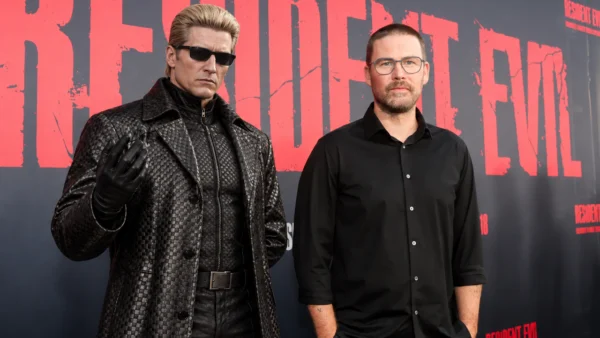

Albert Wesker Reviews the New Resident Evil Film
I have seen Zach Cregger’s Resident Evil. I am not in it.
This is the highest praise I have ever extended to a motion picture.
You may take that as flippancy. It is not. I have a documented cinematic history, and I would like it understood from the outset that my standards for adaptation are no longer artistic. They are protective.
The Film
Cregger has made a film about Bryan, a medical courier played by Austin Abrams, who spends one catastrophic night discovering that his delivery route has developed complications. Sony describes it as an entirely new story and a race for survival, which you may verify at the official Sony Pictures page should you suspect I have seized control of their marketing department.
No mansion. No S.T.A.R.S. No Barry wandering the corridors. At no point does anyone pause to search a desk for ammunition.
Excellent.
I am told this is unacceptable. That a proper adaptation must reproduce the Spencer Mansion, introduce Chris and Jill on schedule, and position Rebecca near the correct bottle of chemicals.
If you want the exact story of Resident Evil, I have remarkable news. Capcom already made it. It is called Resident Evil.
What Cregger understands is that the games frighten you because you are lost, poorly supplied and increasingly suspicious that every door leads to something medically discouraging. Variety’s review notes that the film moves an unusually ordinary man through one escalating danger zone after another. Precisely. A film cannot hand an audience member a controller and instruct him to manage his inventory. It must produce the sensation by other means.
I decline to elaborate. The point is not difficult.
Cregger also told The Hollywood Reporter that he removed jokes after test screenings, having concluded the film worked better when the characters treated the danger seriously. A director observed human behavior, revised his work and improved the result.
Umbrella would have terminated him within the hour.
Now. The Record.
I hold no grievance against Milla Jovovich. One does not blame the syringe.
My objection concerns the gravitational behavior of the films surrounding her, which developed something resembling an autoimmune response whenever another Resident Evil character threatened to become interesting.
Jill Valentine arrives. Alice must be stronger. Nemesis arrives. Alice must fight him personally. Claire Redfield arrives — charming — please stand over there. Leon Kennedy arrives, one of the most recognizable protagonists in the franchise, and becomes a supporting player in a film about Alice.
Ada Wong. Barry Burton. Chris Redfield. Eventually the cast resembled a reunion at which everyone slowly realizes the keynote speaker has not changed.
The problem was never that Alice was new. The problem was that she was load-bearing.
The Peculiar Humiliation of Albert Wesker
In Capcom’s chronology, I command the S.T.A.R.S. unit, betray it, survive a Tyrant by way of an experimental virus, vanish, acquire further biological weapons, manipulate two decades of events and arrive at Uroboros. Capcom documents a considerable portion of this in its official Resident Evil 5 Gold Edition materials.
I did not require the films to reproduce every detail. I required only that they preserve the basic concept that Albert Wesker is not someone’s assistant manager.
The Sunglasses Were Apparently the Entire Brief
Shawn Roberts looked considerably more like me than anyone had a statistical right to expect. The hair was correct. The glasses were correct. The posture suggested a man who found the room biologically disappointing.
For approximately four minutes, I had hope.
In Afterlife, I am enhanced by the T-virus and fight Alice, Chris and Claire, and the sequence borrows freely from Resident Evil 5 — the speed, the glasses, the general impression that gravity has become optional. I could tolerate this.
Then Retribution determines that I am no longer serving Umbrella and dispatches a recruitment offer to Alice so that we might jointly oppose the Red Queen.
The architect of conspiracies. The collector of viruses. A man who has betrayed essentially everyone with whom he has ever shared oxygen.
Assembling a team.
I assume the deleted scenes contain a charity raffle.
Then Came the Door
The Final Chapter completes the work with something close to operatic confidence.
I am revealed to be subordinate to Dr. Alexander Isaacs. Alicia Marcus then clarifies that I am merely an Umbrella employee and fires me. My termination lifts the Red Queen’s restrictions. She drops a blast door on my leg.
Albert Wesker is defeated by human resources.
Consider the engineering. Chris Redfield and Sheva Alomar once required firearms, coordination, experimental ordnance, a bomber, Uroboros and an active volcano to dispose of me. The film required a personnel decision and a door.
I was not defeated. I was offboarded.
Somewhere in that building there was an exit questionnaire.
“Please rate your experience with management.”
“Poor.”
“Would you recommend Umbrella Corporation to a colleague?”
“I will destroy you.”
“Thank you. Your feedback is important to us. Your building access has been revoked effective immediately.”
It was.
Conditional Approval
Which is why I find the current complaints so tiresome. Bryan is not a game protagonist, and this is offered as a defect. It is the film’s principal virtue. Bryan does not steal Leon Kennedy’s story, because Leon Kennedy is not standing beside him looking confused. He does not defeat Jill Valentine at being Jill Valentine. He occupies his own narrative and leaves the rest of us unmolested.
The series has never held still regardless. The first game is claustrophobic survival horror. 4 restructures everything around momentum. 7 abruptly relocates the player into the first person and a grotesque Southern household. Capcom has never treated the formula as sacred. I fail to see why a filmmaker should.
Preserve Umbrella. Preserve the biology. Preserve the suspicion that the next room contains something nature did not authorize.
Then create.
So demand your mansion. Demand the police station. Demand every herb placed precisely where Capcom left it in 1998. I shall be elsewhere, enjoying the mutation — and savoring the single greatest achievement of Cregger’s film, which is that at no point in its runtime does anyone fire me.
Evolution has never required permission from the original.
Neither, apparently, does the personnel department.
ALBERT WESKER DEMANDS YOU VISIT:RESIDENT EVIL WORLD


OR CHECK OUT THE LATEST BLOG DROPPING:D.C. Douglas Returns as Lysandre in Pokémon Masters EX
Film & Television work. 🎙️HEAR MY VOICE:
Voice Over work. 🎪CONVENTIONS:
Book me for your con! 🩶THE DC STORE:
Learn about Cameos!
I'm such a whore. 🎪LIVE IN PERSON:
Public nuisance posts. 🗣️INTERVIEWS:
Posts from my butt. 🍷GREEN ROOM:
BTS & L.A. life. 🧪RESIDENT EVIL WORLD:
Wesker fetish? 💫TALENT SPOTLIGHT:
Stalker crib notes.