
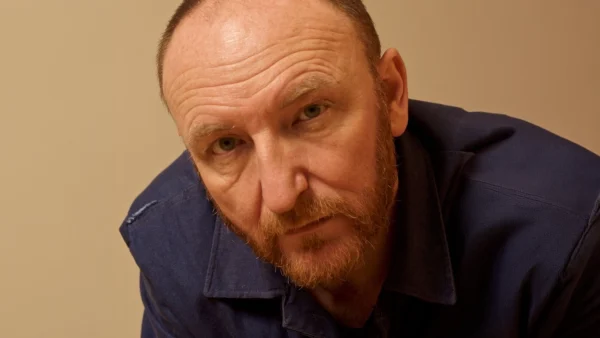

Gather ‘round, citizens of the digital age, and prepare your ear-trumpets for the chronicling of a man whose voice sounds like a landslide occurring inside a velvet-lined casket. We speak, of course, of the formidable, the frequently bearded, and the perpetually intense Antony Byrne. A man so skilled at playing the sort of fellow you wouldn’t want to meet in a dark alley, or a well-lit drawing room, for that matter, that he has become the go-to architect for high-stakes menace across the British stage and global screen.
The Genesis of a Grumble: Early Years and the Thespian Calling
Before he was orchestrating the downfall of industrial empires or lurking in the shadows of survival horror masterpieces, Antony Byrne was a young man endowed with a skeletal structure and a vocal cord arrangement that screamed “classical training.”Born in the mid-1960s, a decade noted for its questionable fashion but excellent acoustics, Byrne did not simply fall into acting; he pursued it with the focused determination of a badger chasing a particularly succulent worm.
His journey through the hallowed halls of dramatic education was less about learning to “be” a tree and more about mastering the art of the Presence. One does not simply stand on a stage with Antony Byrne; one occupies the space remaining after he has finished looming. This early mastery of the “Loom” (a technical theatrical term involving height, eyebrows, and a refusal to blink) paved the way for a career that would eventually span the Royal Shakespeare Company, the gritty streets of Birmingham, and the digital landscapes of Capcom.
The Royal Shakespeare Company: A Thumping Good Time with Iambic Pentameter
If there is a place where a man can truly stretch his metaphorical and literal legs, it is the Royal Shakespeare Company (RSC). Byrne didn’t just join the RSC; he became a structural pillar of it. Over the decades, he has tackled the Bard’s most complex figures with a vigor that suggests he might actually believe he’s in 16th-century Verona and is quite cross about the lack of modern plumbing.
The Kingly and the Killer
In his tenure with the RSC, Byrne has played everything from the noble to the nefarious. His portrayal of King Lear in various capacities, or his turns in Henry VI and Richard III, showcased a man who could handle a crown without looking like he’d borrowed it from a pantomime. In the 2012 production of The Orphan of Zhao, he brought a gravitas to the stage that made the scenery consider bowing. He didn’t just speak the lines; he chewed them with a refined dignity, ensuring that every syllable reached the back row and perhaps even the neighboring county.
His work in King Learspecifically under the direction of Gregory Doran, saw him embodying the Duke of Albany with a stoicism that provided a necessary anchor to the surrounding madness. It is this ability to remain the calm, terrifying center of a storm that would eventually make him the darling of television casting directors looking for someone who could look “quietly homicidal” during a dinner party.
Television: From Peaky Blinders to the Policing of Dublin
While the stage offered him the chance to shout at ghosts and wear doublets, television offered Antony Byrne the chance to wear very nice suits and threaten people with much more modern weapons. His screen career is a masterclass in the “Character Actor’s Gambit,” appearing in everything that matters while maintaining an air of mystery that suggests he might actually be a high-ranking intelligence officer in real life.
The Shadow of Peaky Blinders
It was in the smokey, soot-stained world of Peaky Blinders that Byrne truly cemented his status as a titan of the small screen. Playing the role of Billy Grade, he navigated a world of razor-bladed caps and Irish whiskey with a nuanced vulnerability. It was a departure from his usual “Immovable Object” archetype, showing a man caught between the gears of the Shelby machine. Watching Byrne’s face as Billy Grade realized the depth of his predicament was like watching a slow-motion film of a man realizing he’s accidentally stepped onto a very large, very hungry crocodile.
The Procedural Powerhouse
Byrne has also been a staple of the British procedural. From The Bill to Silent Witness, and into the gritty corridors of Dublin Murders, he has played both sides of the law with equal conviction. In Dublin Murders, his portrayal of O’Kelly was a masterclass in the “Weary Superior”: a man who has seen too many bodies and not enough cups of decent tea. It is a testament to his range that he can move from the operatic heights of Shakespearean tragedy to the damp, grey realism of an Irish precinct without losing an ounce of his inherent magnetism.
Digital Dominance: The Voice That Rattles Controllers
In the 21st century, a truly great actor must eventually find themselves inside a sound booth, wearing a tight suit covered in ping-pong balls, or at the very least, shouting into a high-end microphone for the benefit of gamers worldwide. Antony Byrne has embraced this with the same ferocity he brings to the stage.
The Witcher and Beyond
Players of The Witcher 3: Wild Hunta game where almost everyone sounds like they’ve been gargling gravel, will recognize Byrne’s distinct resonance. He provided voices for several characters, including the memorable General Nilfgaardian officers who made players feel like they hadn’t done their homework. His voice carries an innate authority; when an Antony Byrne character tells you to “halt,” you don’t just stop walking; you consider apologizing for existing in the first place.
Resident Evil Requiem: The Rise of Victor Gideon
Most recently, the world of survival horror has been set ablaze by his performance in Resident Evil Requiem . As Victor Gideon, the primary antagonist of the 2026 masterpiece, Byrne has created a villain for the ages. Gideon isn’t just a “mad scientist” or a “mutated monstrosity”; he is a Byrne-ian creation: articulate, terrifyingly logical, and possessing a voice that seems to vibrate the very plastic of the player’s headset. The search rankings for his name spiked precisely because players wanted to know who the man was that made them feel so intellectually inferior right before he tried to have them eaten by a bioweapon.
For more details on his extensive credits, one might consult his official IMDb profile , which serves as a digital receipt for several decades of being better at acting than almost everyone else.
The Art of the Menacing Stare
What sets Byrne apart in the crowded field of “Tall Men Who Look Serious” is his technical precision. There is a specific geometry to an Antony Byrne performance. It starts in the brow, descends through a gaze that could peel paint, and culminates in a vocal delivery that respects the silence between the words. He understands that a pause can be more frightening than a scream, and that a slight adjustment of a tie can be as violent as a sword fight.
Collaborations and Consistency
He has frequently collaborated with the industry’s most demanding directors, appearing in projects like The Ghost Writer (directed by Roman Polanski) and Hanna. Whether he is on screen for sixty minutes or sixty seconds, he leaves a mark. He is the “Actor’s Actor,” the one your favorite stars are slightly nervous to do a scene with because they know he’s going to steal it simply by standing there and breathing with professional intent.
A Curriculum Vitae of Chaos
His filmography reads like a checklist of “Quality British Drama.”
- Hanna: Providing the kind of grit that only a man of his stature can.
- The Witcher 3: Wild Hunt: Lending his vocal gravitas to the Continent.
- Peaky Blinders: Making the 1920s look even more dangerous than the history books suggested.
- Resident Evil Requiem : Ensuring that “Victor Gideon” will be a name whispered in terror for years to come.
The Technicality of the Byrne Persona
Let us explore into the “Byrne Method.” While many actors “find the character” through costume or back-story, Byrne seems to find the character through the weight of the air around him. In his Shakespearean roles, he navigated the complex verse with a clarity that made 400-year-old jokes actually land, a feat that usually requires a miracle or a very drunk audience. In his modern roles, he strips away the artifice, leaving behind a raw, jagged edge that feels dangerous. He doesn’t just “play” a villain; he justifies the villain’s existence until you’re halfway convinced that burning down the city is actually a very sensible urban planning decision.
His physical presence is equally calculated. Standing at a height that allows him to look down on most of humanity, he uses his frame not just to intimidate, but to communicate. In Requiem, the motion-capture work he provided for Gideon captured the fluid, predatory grace of a man who knows exactly where the exits are and has already locked them from the outside. It is a performance that bridges the gap between the classical theatre and the high-tech future of digital entertainment.
And so, we find ourselves at the end of this digital parchment, having explored the vast, craggy landscape of Antony Byrne’s career. He remainsa man of profound mystery and immense talent, a creature of the stage who successfully colonized the screen, and a voice that will continue to haunt our dreams and our gaming consoles alike. Should you ever find yourself in a room with him, my advice is simple: stand up straight, speak clearly, and for heaven’s sake, don’t mention the beard unless he brings it up first. He is a marvel, a menace, and a master of the craft, a true colossus of the modern age who probably knows exactly what you’re thinking and finds it slightly disappointing.
Now Read The VO Dirt!Voice Actors D.C. Douglas Knows and Loves!


OR CHECK OUT THE LATEST BLOG DROPPING:D.C. Douglas Returns as Lysandre in Pokémon Masters EX
Film & Television work. 🎙️HEAR MY VOICE:
Voice Over work. 🎪CONVENTIONS:
Book me for your con! 🩶THE DC STORE:
Learn about Cameos!
I'm such a whore. 🎪LIVE IN PERSON:
Public nuisance posts. 🗣️INTERVIEWS:
Posts from my butt. 🍷GREEN ROOM:
BTS & L.A. life. 🧪RESIDENT EVIL WORLD:
Wesker fetish? 💫TALENT SPOTLIGHT:
Stalker crib notes.