
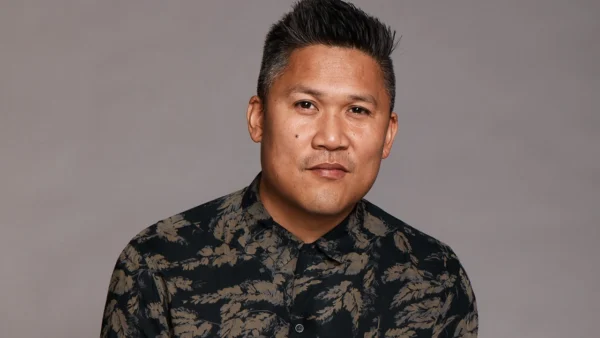

The California Origin Story
Dante Basco entered the world in 1975 in Pittsburg, California. The town is primarily known for having a name that people constantly misspell by adding a silent h at the end. He did not spend his childhood staring at the walls or contemplating the heat. Instead, he joined his brothers in a breakdancing crew known as the Street Freaks. While most children were busy learning how to tie their shoes or failing basic arithmetic, Basco was performing for audiences and mastering the art of the headspin. It was a loud, kinetic introduction to the world of performance. The family eventually moved to Los Angeles, a city built on the broken dreams of thousands, but the Basco siblings decided to actually find work instead. He attended the Orange County High School of the Arts, which is a place where teenagers go to become professional extroverts. His early career consisted of the usual grind of commercials and minor television spots that most actors would prefer to bury in a desert. However, Dante Basco’s IMDb profile confirms that he was remarkably efficient at staying employed during an era when Hollywood was not exactly searching for Filipino-American leading men. He simply made himself impossible to ignore. He was a working actor before he was old enough to legally drive a car to a set.
The Mohawk and the Hook
In 1991, Steven Spielberg decided to make a film about what happens when Peter Pan forgets how to fly. The result was Hook. Basco was cast as Rufio, the leader of the Lost Boys. The role required him to wear a tri-colored mohawk that likely weighed more than his own head and a costume that appeared to be made from the discarded remains of a high-end upholstery shop. Rufio was arrogant, loud, and ended up dying at the hands of Captain Hook. It was a spectacular way to spend a Tuesday. The performance became a cult touchstone. Basco managed to project a sense of feral authority that made children across the globe want to scream the word Bangarang at their parents during dinner. The role established him as a recognizable face in a massive franchise. Critics at the time, including those in this Variety Review of Hook, noted the energy of the Lost Boys. Basco was the clear engine of that group. He carried the film’s adolescent angst with more weight than the script probably deserved. After Hook, he did not just disappear into the abyss of child-actor obscurity. He starred in The Debut in 2000, a film that focused on the Filipino-American experience and proved he could lead a narrative without the help of a pirate ship or a magical shadow.
The Technical Mechanics of Vocal Fire
The transition from a physical actor to a voice-over powerhouse is usually where careers go to die. Basco avoided this by becoming the crown prince of animated fire. In 2005, he began voicing Prince Zuko in Avatar: The Last Airbender. It was a role that spanned three seasons and required him to transition from a screaming antagonist to a quiet, conflicted hero. Most actors would have played the role with a generic growling sound. Basco did something much more annoying for his throat but significantly better for the audience. He didn’t just walk into a recording booth; he entered it with the weary resignation of a man who knows he is about to become a thousand children’s internal monologue. He followed this with American Dragon: Jake Long, where he voiced the lead from 2005 to 2007, solidifying his status as the voice of early millennium adolescence.
Performance Analysis
From a craft perspective, Basco’s work as Zuko is a study in vocal placement and the management of glottal tension. He frequently utilizes a rasp that sits high in the larynx, which effectively communicates a character who is perpetually on the verge of a physical or emotional breakdown. In the industry, this is often called gritty resonance. He maintains this texture even during high-intensity ADR sessions where he must match the frantic movements of the animation. His ability to modulate his volume without losing that specific, scarred timbre is why the performance feels grounded rather than cartoonish. He understands that a character’s pain is often heard in the exhale, not just the shout. This kind of technical control allows for a consistent character arc that survives the chaotic nature of television production schedules. It is a masterclass in using vocal strain as a storytelling device without actually destroying one’s vocal cords before the second act.

Dante Basco, Phil LaMarr, Ian Sinclair, Joel McDonald with DC Douglas at various cons
The Directorial Pivot and Recent History
In 2021, Basco decided that acting in other people’s movies was not enough of a challenge, so he directed, wrote, produced, and starred in The Fabulous Filipino Brothers. The film is a family affair in the most literal sense possible. It features his real-life siblings Derek, Darion, Dionysio, and Arianna Basco. Set in their hometown of Pittsburg, the movie uses a series of vignettes to explore the chaos of a family wedding. It is a rare example of a passion project that actually managed to get finished and distributed. Basco plays Duke, the golden child of the family who travels to Manila for a speaking engagement. The film received positive attention for its authenticity, as seen on The Fabulous Filipino Brothers Rotten Tomatoes page. He followed this with a role in the 2023 film Asian Persuasion, playing Mickey de los Santos. Even in 2026, he remains deeply connected to the world of Avatar through his podcast, Avatar: Braving the Elements, which he hosts with Janet Varney. While rumors circulate about his involvement in new animated features, he continues to treat his legacy with a mixture of professional pride and the casual indifference of a man who has already won the game. He also appeared in the 2025 project One Big Happy Family, proving that he has no intention of retiring to a quiet life of gardening.
Industry Impact and Persistent Cool
In an industry that often views diversity as a seasonal trend, Basco has occupied space with the permanence of a load-bearing wall. He managed to survive the 90s, the 2000s, and the transition to digital media without losing his relevance or his hairline. Dante Basco remains solid evidence of what happens when you combine technical skill with the ability to look cool in a leather vest. He has navigated the industry for over three decades without a public meltdown or a scandalous court appearance. This is his most impressive feat. He remains a fixture on the convention circuit, where people still ask him to say Bangarang while he tries to maintain the dignity of a grown man. He has bridged the gap between the era of practical effects and the era of digital fire-bending, all while keeping his sense of humor intact.
He is a man who successfully convinced a generation of teenagers that having a scar and a bad attitude was a valid personality trait. Basco will likely be voicing angst-ridden princes until the sun burns out, and honestly, the industry is probably better for it. He came, he saw, he yelled at a pirate, and he became the definitive voice of a generation of people who still think they can move water with their minds. If there were a Nobel Prize for staying relevant while wearing a mohawk, he would have three by now, but since there isn’t, he will just have to settle for being the coolest person in every room he enters.
Learn how D.C. Douglas Annoyed Dante Basco:Voice Actors D.C. Douglas Knows and Loves!


OR CHECK OUT THE LATEST BLOG DROPPING:D.C. Douglas Joins Disney+’s Vampirina Season 2 as Speaker of Books
Film & Television work. 🎙️HEAR MY VOICE:
Voice Over work. 🎪CONVENTIONS:
Book me for your con! 🩶THE DC STORE:
Learn about Cameos!
I'm such a whore. 🎪LIVE IN PERSON:
Public nuisance posts. 🗣️INTERVIEWS:
Posts from my butt. 🍷GREEN ROOM:
BTS & L.A. life. 🧪RESIDENT EVIL WORLD:
Wesker fetish? 💫TALENT SPOTLIGHT:
Stalker crib notes.