
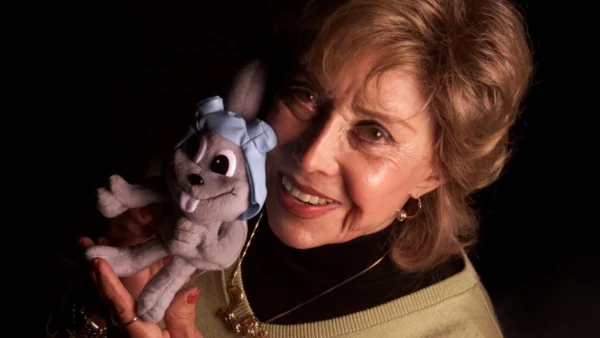

The Irresponsible Longevity of June Foray
June Foray entered the world in 1917, a year mostly famous for global upheaval and the utter lack of decent recording equipment. While most twelve year olds in Springfield, Massachusetts, were occupied with the rudimentary tasks of basic survival or perhaps learning to operate a butter churn, Foray was already infiltrating the radio airwaves. She did not merely participate in the medium; she colonized it. By the time she moved to Los Angeles in the 1930s, her vocal cords had already reached a level of efficiency that was frankly an administrative nightmare for her competitors. It is deeply irritating that one person could possess such a range without the common decency to share some of that talent with the rest of us who struggle to maintain a consistent pitch during a sneeze.
Her career was not a sequence of events so much as it was a relentless siege on the casting offices of Hollywood. She began by providing the voice for Lucifer the cat in the 1950 production of Cinderella, a role that required her to sound both feline and diabolical (a redundancy for anyone who has ever shared a room with a cat). This performance was followed by a stint as the squaw in Peter Pan in 1953, where she continued to prove that she was the only person in California capable of making a paycheck by talking to herself. Her June Foray’s expansive IMDb credits reveal a resume that is geographically impossible and logically confusing. It is a list so long it could be used as a structural support beam for a medium sized municipal library.
The Squirrel, the Spy, and the Terrible Burden of Versatility
In 1959, Foray signed on for The Rocky and Bullwinkle Show, where she played both Rocky the Flying Squirrel and the villainous Natasha Fatale. This was a move of pure professional arrogance. To voice a high-pitched, earnest rodent and a sultry, homicidal Russian spy in the same session is a feat that defies the basic laws of laryngeal physics. She made the transition look as simple as boiling an egg, which is particularly insulting to those of us who regularly burn toast. Her portrayal of Rocky was a masterpiece of moral clarity and questionable aerodynamics. Meanwhile, as Natasha, she channeled a specific kind of Cold War menace that was surprisingly effective for a cartoon intended to sell cereal to children.
She did not stop at squirrels and spies. In 1963, she voiced Talky Tina in the The Twilight Zone episode titled Living Doll, creating a character so unsettling that it remains the primary reason many adults still refuse to sleep in a room with a porcelain doll (a perfectly rational fear, in my estimation). Then came 1966, when she voiced Cindy Lou Who in How the Grinch Stole Christmas!. She played a child who was no more than two, despite being nearly fifty years old at the time. This level of age defiance is usually reserved for mythological entities or very well-maintained 1994 Toyota Corollas. It is entirely possible she was not a human woman at all, but rather a sentient collection of resonators disguised as a grandmother.
A Professional Autopsy of the Foray Flip
From a technical standpoint, Foray’s work represents a terrifyingly precise mastery of the vocal tract. Observing her performance is like watching a watchmaker assemble a movement while wearing mittens, except she is doing it with her throat. When she switched from the head voice required for Rocky into the deep, glottal-heavy register of Natasha Fatale, she wasn’t just changing pitch; she was reconfiguring her entire internal architecture. Rocky exists almost entirely in the mask, using a tight pharyngeal focus that would make a trained opera singer weep with envy. It is a bright, forward sound that carries the weight of a feather but the clarity of a church bell.
Then, without so much as a sip of water or a moment to reconsider her life choices, she would drop the sound into her chest to find Natasha. This shift requires a massive relaxation of the vocal folds followed by a sharp, controlled constriction to produce that signature smoky rasp. Maintaining character consistency during such a flip is an act of extreme mental gymnastics (similar to trying to calculate your taxes while falling down a flight of stairs). She didn’t just hit the notes; she lived in the spaces between them, ensuring that every grunt and gasp remained tethered to the character’s core identity. It was a display of technical control that makes most modern acting look like a series of accidental noises.
The Monopoly on Animation History
Foray’s influence on the industry was so complete that she eventually just started her own awards ceremony because, presumably, she was tired of waiting for other people to notice how much better she was than everyone else. She was a founding member of ASIFA-Hollywood and the driving force behind the Annie Awards, which began in 1972. The fact that the Variety’s obituary on her death reads like a history of the medium itself is a testament to her refusal to retire at a sensible age. She voiced Granny for the official Warner Bros. Looney Tunes page and its various spin-offs for decades, providing a steady hand for Sylvester and Tweety while the rest of the world descended into chaos.
Even in her later years, she continued to voice Magica De Spell in DuckTales and reprised the role for the 2013 video game remake, proving that she could still sound more threatening than a tax audit well into her nineties. She won a Daytime Emmy at age 94, which is a age when most people are content if they can remember where they put their glasses. Her life was a long, loud, and incredibly busy stretch of time that forced everyone else in the voice acting community to settle for second place. It was a legendary career, though I suspect it was mostly a very clever way to avoid having to speak in her own voice for more than ten minutes at a time.
Eventually, the universe realized that allowing June Foray to continue would violate several key principles of the space-time continuum, and she passed away in 2017 at the age of 99. She left behind a body of work so vast that if you played every one of her performances back-to-back, you would likely miss the next three presidential elections and several minor lunar eclipses. She was the grandmother of animation, the queen of the vocal booth, and a persistent reminder that some people are simply better at being alive than the rest of us. It was an exhausting performance, really, but one that luckily saved the world from the horror of a cartoon squirrel sounding like a regular, untalented human being.
Now Read The VO Dirt!Voice Actors D.C. Douglas Knows and Loves!


OR CHECK OUT THE LATEST BLOG DROPPING:D.C. Douglas Joins Disney+’s Vampirina Season 2 as Speaker of Books
Film & Television work. 🎙️HEAR MY VOICE:
Voice Over work. 🎪CONVENTIONS:
Book me for your con! 🩶THE DC STORE:
Learn about Cameos!
I'm such a whore. 🎪LIVE IN PERSON:
Public nuisance posts. 🗣️INTERVIEWS:
Posts from my butt. 🍷GREEN ROOM:
BTS & L.A. life. 🧪RESIDENT EVIL WORLD:
Wesker fetish? 💫TALENT SPOTLIGHT:
Stalker crib notes.