
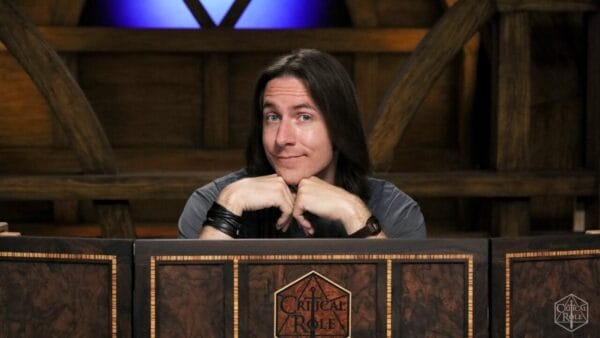

The Architect of Imaginary Syllables: The Matthew Mercer Chronicle
It is a truth universally acknowledged that a man in possession of a magnificently conditioned larynx, an encyclopedic knowledge of medieval weaponry, and a suspiciously luxurious head of hair must eventually find himself trapped in a soundproof room, shouting at a microphone. Such is the baffling, highly improbable, and entirely spectacular existence of Matthew Mercer. To categorize him merely as a voice actor is a profound disservice to a man who functions more as a heavily caffeinated demigod of auditory creation. If one were to consult the prestigious and unyielding digital archives of the Internet Movie Database , one would discover a staggering ledger of belligerent cowboys, melancholic samurai, heavily armed royalty, and a frankly alarming number of supernatural monsters, all of whom inexplicably share the exact same respiratory system.
Mercer has conquered the modern entertainment landscape not by showing his physical form, though the hair remains a vital component of his public mythology, but by weaponizing his vocal cords. He is a man who realized that the most logical career path in a chaotic universe was to sit in a padded booth, pretend to be a highly aggressive elf, and occasionally roll polyhedral dice for an audience of millions.
The Genesis of Noise: From High School Drama to the Dubbing Booth
Before he was a gunslinger or a dungeon-mastering deity, Matthew Christopher Miller was a relatively standard human adolescent born in the summer of 1982. Recognizing early on that the physical world was fundamentally drafted and thoroughly exhausting, young Matthew sought refuge in the theater. The theater, after all, is a socially acceptable environment for individuals who wish to aggressively pretend to be other people while wearing uncomfortable trousers.
However, the transition from traditional stage acting to the peculiar art of voiceover occurred when Mercer discovered that the universe of Japanese animation required English-speaking individuals capable of screaming for unnatural lengths of time while matching the lip movements of two-dimensional characters. It is an art form that requires the lung capacity of a pearl diver and the rhythmic precision of a Swiss metronome. Mercer, armed with an absurdly flexible vocal range and a willingness to hyperventilate on cue, dove headfirst into the dubbing industry. He navigated the murky, chaotic waters of background voices and incidental grunts, slowly building a resume comprised entirely of producing noises that shatter glass and alarm local dogs.
The Anime Crucible: Titans, Delinquents, and High Art
Once an actor successfully proves they can match the erratic mouth-flaps of a highly caffeinated cartoon character, the industry tends to reward them with increasingly bizarre assignments. Mercer’s ascent into the upper echelons of voice acting royalty was paved with the blood of fictional giants and the stoic silence of supernatural teenagers.
Levi Ackerman and the Art of Aggressive Hygiene
In the global animated phenomenon known as Attack on Titan , Mercer was tasked with providing the English voice for Captain Levi Ackerman. The character brief was wonderfully absurd: a man who is simultaneously the most lethal, high-flying, sword-wielding killer of giant, naked, flesh-eating monsters, and also a man deeply, pathologically concerned with keeping his immediate surroundings perfectly dusted. Mercer approached this paradox with the gravity of a Shakespearean tragedy. He imbued Levi with a voice that is cold, flat, and terrifyingly competent, proving that true menace does not require shouting, but rather a quiet, gravelly assurance that you will be dismantled before you can finish your tea.
Jotaro Kujo and the Geometry of Pointing
If Levi Ackerman was an exercise in restrained violence, Mercer’s turn as Jotaro Kujo in the magnificently unhinged JoJo’s Bizarre Adventure was an exploration of aggressive stoicism. The role primarily required Mercer to sound incredibly bored by the fact that he was fighting vampires and supernatural punch-ghosts, while simultaneously pointing at them with extreme prejudice. It takes a very specific, highly trained theatrical pedigree to deliver catchphrases about how annoying the universe is, right before unleashing a flurry of invisible, rapid-fire punches. Mercer executed it with the absolute certainty of a man who knows his hat has inexplicably fused with his hair.
The Digital Frontier: Cowboys, Princes, and the Undead
As the video game industry blossomed into a multi-billion-dollar behemoth, directors rapidly realized that Mercer possessed the ultimate secret weapon: a baritone that makes the listener want to immediately stand up straight and pledge allegiance to an imaginary kingdom. He became the undisputed king of the interactive protagonist, a man tasked with guiding millions of players through highly dangerous digital landscapes.
High Noon in the Recording Studio
In the realm of competitive team-based shooters, Mercer achieved a terrifying level of cultural omnipresence in Overwatch. Cast as Cole Cassidy, Mercer was handed the role of a futuristic cowboy who inexplicably wears a serape, smokes cigars, and relies on a six-shooter in a universe populated by cybernetic ninjas and hyper-intelligent gorillas. It is a concept so spectacularly silly that it requires utter commitment. Mercer leaned into the gritty, sun-baked drawl with such magnificent force that his iconic ultimate line caused an entire generation of gamers to immediately dive for cover the moment they heard his voice echo across the digital battlefield.
Royalty, Zombies, and The King of Evil
Lest one assume Mercer is entirely consumed by futuristic firearms, he has remained a steadfast presence in fantasy and horror. He voiced the noble, heavily armored Chrom in Fire Emblem Awakening, providing a masterclass in how to sound terribly regal while discussing the statistical probability of landing a critical hit with a magic sword. He inherited the iconic, zombie-dodging mantle of Leon S. Kennedy in Resident Evil 6 and the animated film Resident Evil: Damnation, perfecting the art of the heroic, exhausted sigh in the face of biological monstrosities.
Yet, perhaps his crowning achievement in the realm of interactive villainy arrived with the release of The Legend of Zelda: Tears of the Kingdom. Nintendo, a company generally known for cheerful plumbers and pink puffballs, required a voice for Ganondorf, the absolute, undisputed sovereign of malice. Mercer reached deep into his diaphragm and produced a voice that sounded like tectonic plates grinding together in a very foul mood. It was a performance that finally gave the legendary antagonist a booming, theatrical gravitas, ensuring that the apocalypse sounded remarkably eloquent.
He further cemented his absolute dominion over massive role-playing games by portraying the beloved, hamster-wielding berserker Minsc in the monumental Baldur’s Gate 3, and the brooding, vampiric gunslinger Vincent Valentine in Final Fantasy VII Rebirth. One simply cannot release a major video game in the modern era without Matthew Mercer providing at least one deeply traumatized man with excellent combat skills.
The Critical Role Anomaly: Herding Cats and Rolling Dice
If Matthew Mercer’s story ended with him being one of the most prolific voice actors of his generation, it would be a perfectly respectable, sensible tale. However, the universe, possessing a tremendously twisted sense of humor, decided that Mercer’s true destiny lay in sitting around a wooden table with his friends and playing a tabletop game.
Critical Role began as a private game of Dungeons and Dragons among a group of highly trained vocal professionals. In a maneuver of sheer, unadulterated madness, they decided to broadcast their game on the internet. The concept, watching other people do math and pretend to be wizards for four hours at a time, should have been a catastrophic failure. Instead, it became an international media empire.
As the Dungeon Master, Mercer essentially serves as the author, director, and entire supporting cast of a wildly unpredictable fantasy epic. He sits behind a small cardboard screen and single-handedly voices hundreds of non-player characters, ranging from sinister gods and ancient dragons to remarkably unhelpful shopkeepers and highly suspicious pastries. He is the architect of the world of Exandria, a realm born entirely from his own furiously working imagination and a profound willingness to do funny voices at his friends until they cry.
The success of this endeavor defies all logical explanation. It spawned massive Kickstarter campaigns, comic books, and the wildly successful animated series The Legend of Vox Machina and its upcoming successor, Mighty Nein. Mercer essentially transitioned from a man who voices characters in other people’s worlds, to a man who simply built his own universe and invited everyone else to live in it.
The Philosophy of Polyrhythmic Nonsense
Surviving and thriving in an industry that demands the constant, aggressive contortion of the vocal cords requires a constitution of iron and a thoroughly robust sense of the absurd. Mercer approaches his highly peculiar art form with the discipline of a classical maestro. He understands that a voice is not merely a funny noise; it is the entire emotional center of a drawn image or a digital model. Without his precise application of breath, pacing, and pitch, a beautifully rendered sequence is nothing more than a silent pantomime.
It is a demanding profession that requires one to stand in a small, acoustically deadened room, simulate the horrific agony of being set on fire, and then politely ask the audio engineer if they would like another take. It requires one to summon tears for a tragic backstory, only to immediately switch gears and provide the sound of a goblin falling down a remarkably long flight of stairs. It is the purest form of theatrical imagination, unfiltered by the physical constraints of reality.
So, the next time an animated swordsman executes a physically impossible maneuver, or a digital cowboy steps into the midday sun, or an entire fantasy universe hangs in the balance of a rolling twenty-sided die, take a moment to appreciate the sheer, unbridled majesty of the man behind the microphone. Raise a metaphorical tankard of ale to the sovereign of the sound booth, a performer who looked at the rigid, terribly sensible rules of the physical world and decided, with tremendous vocal gusto, to entirely ignore them in favor of building a vastly superior reality out of thin air, sheer volume, and an aggressively organized collection of tabletop miniatures.
Learn how D.C. Douglas Annoyed Matthew Mercer:Voice Actors D.C. Douglas Knows and Loves!


OR CHECK OUT THE LATEST BLOG DROPPING:D.C. Douglas Returns as Lysandre in Pokémon Masters EX
Film & Television work. 🎙️HEAR MY VOICE:
Voice Over work. 🎪CONVENTIONS:
Book me for your con! 🩶THE DC STORE:
Learn about Cameos!
I'm such a whore. 🎪LIVE IN PERSON:
Public nuisance posts. 🗣️INTERVIEWS:
Posts from my butt. 🍷GREEN ROOM:
BTS & L.A. life. 🧪RESIDENT EVIL WORLD:
Wesker fetish? 💫TALENT SPOTLIGHT:
Stalker crib notes.