
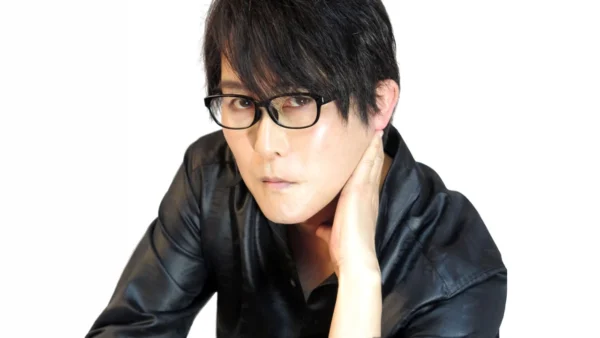

The Anatomy of a Sonic Boom
Good day to you, assuming the day has sought your permission to be good. We are gathered here in the digital ether to discuss a man whose vocal cords possess the kind of raw, unadulterated power usually reserved for geological events or particularly angry badgers. Takehito Koyasu is not merely a voice actor. He is an acoustic weapon, a maestro of the sinister chuckle, and quite possibly the only person on earth who can make the alphabet sound like a threat to international security. Born on the fifth of May in the year 1967 in Yokohama, Japan, Koyasu entered a world that was entirely unprepared for the sheer baritone resonance he would eventually unleash upon it. One likes to imagine that his first cries as an infant shattered the hospital windows and caused local wildlife to migrate early, though medical records frustratingly refuse to confirm this.
To understand the trajectory of this man is to understand the history of modern Japanese animation. He has been a staple of the medium for over three decades, lending his voice to aristocrats, masked political dissidents, lazy admirals, giant apes, and whatever on earth Excalibur is supposed to be. If a character enters a scene radiating an aura of dangerous competence paired with an alarmingly flamboyant wardrobe, there is a ninety-five percent statistical probability that Takehito Koyasu is providing the vocals. He has built an entire empire on sounding simultaneously seductive and utterly terrifying, a combination that frankly saves animation studios millions in character development.
Early Days and Masked Agendas
Before he was stopping time and throwing construction equipment at teenagers, Koyasu had to establish himself in an industry saturated with talent. He made his grand entrance in the late 1980s, eventually securing roles that required a certain aristocratic detachment. Take, for instance, his portrayal of Snufkin in the 1990s animated adaptation of Moomin. Here we have a philosophical vagabond who wanders the valleys playing a harmonica. It is a gentle role, a quiet role, and it proves that Koyasu can, in fact, use an inside voice when strictly required by law or Finnish literature.
However, the universe quickly realized that wasting such a voice on a peaceful wanderer was akin to using a jet engine to dry your laundry. Thus came the era of the magnificent antagonists. He stepped into the highly polished boots of Zechs Merquise in Mobile Suit Gundam Wing. Zechs is a man who wears a giant silver mask for reasons that are deeply political and incredibly dramatic. Koyasu delivered lines about war, peace, and giant robots with a theatrical gravitas that made viewers forget they were watching an advertisement for plastic model kits. He proved that if you speak with enough conviction, people will absolutely ignore the fact that you are wearing a metal bucket on the top half of your face.
A Bizarre Turn of Events: The Era of DIO
Now we arrive at the absolute crux of the biscuit. We must discuss a franchise so utterly divorced from conventional logic that attempting to explain it to a layman usually results in a mild migraine. We are, of course, talking about JoJo’s Bizarre Adventure . When David Production decided to adapt the legendary manga, they needed a voice for Dio Brando. This character is the central antagonist of the entire saga. He is a Victorian youth who poisons his adoptive father, becomes a vampire, survives at the bottom of the ocean for a century, attaches his severed head to the body of his nemesis, and eventually learns how to stop the very flow of time itself. This is not a role for a subtle actor. This is a role for a man who eats scenery for breakfast and asks for a second helping of curtains.
Stopping Time and Shouting at Teenagers
Takehito Koyasu did not just voice DIO. He possessed the character. He grabbed the concept of the character by the throat, dragged it into a recording booth, and forced it to achieve perfection. In the first part, Phantom Blood, Koyasu provides the petulant, scheming, and deeply arrogant voice of a young man who decides to reject his own humanity because he is simply that annoyed by his stepbrother. The transition from a conniving Victorian scoundrel to an all-powerful immortal is entirely seamless, anchored by Koyasu perfectly modulating his arrogance.
But it is in the third part, Stardust Crusaders, that Koyasu elevates the performance from mere acting to a historical event. When DIO finally reveals himself in Egypt, he has ascended beyond mortal concerns. He is clad in yellow, wearing a heart motif on his forehead, and sporting elf shoes. Koyasu matches this visual absurdity with a vocal performance that defies the laws of physics. His battle cries are the stuff of legend. The infamous “Muda Muda Muda” barrage is delivered with a staccato ferocity that requires the lung capacity of a blue whale. The word translates to “useless,” and Koyasu repeats it roughly seventy times a minute to ensure his opponents fully grasp their own inadequacy.
When DIO activates his ability to stop time, his Stand, “The World”, it is not a quiet command. It is a bellow. It is an act of sheer domination over the universe. It is Takehito Koyasu telling the fabric of reality itself to kindly pause while he throws knives at a seventeen-year-old Japanese student. His legendary shout of “Za Warudo” has become a cultural touchstone. And one must mention the road roller. This is the moment where DIO drops heavy construction equipment on a teenager while screaming about his utter uselessness. This is not standard behavior for a Tuesday afternoon, but Koyasu delivers it with the intensity of a man who has just discovered he was overcharged at the bakery and decides the entire planet must suffer. His performance redefined the character for an entire generation, setting a bar for anime villains so high it requires a stepladder to merely gaze upon it.
The Extended Rogues Gallery
While the shadow of DIO looms large, it is important to remember that Koyasu is a deeply versatile actor who occasionally plays other men with questionable motives and excellent posture. He has essentially spent his entire career in the business of terrorizing various animated protagonists across the entire spectrum of Japanese pop culture.
Titans, Sorcerers, and Holy Swords
Let us shift to a world where humanity is largely considered an appetizer by giant naked people. Attack on Titan. Here, Koyasu provides the voice for Zeke Yeager. One might look at a giant, hairy ape titan that throws crushed boulders at screaming scouts like an overgrown child playing baseball and think, “What voice does this monstrosity need?” The answer, obviously, is a smooth, professorial baritone. Koyasu makes Zeke sound like a man who is terribly sorry he has to exterminate your entire race, but it is simply a matter of scheduling. He brings a terrifying calm to mass destruction.
Then we have the sheer audacity of Toji Fushiguro in Jujutsu Kaisen. This is a man who is incredibly financially irresponsible, terrible at parenting, and capable of dismantling the most powerful sorcerers in existence with a pocket knife and a worm he keeps wrapped around his waist. Koyasu’s portrayal is a masterclass in aggressive apathy. Toji sounds like a man who is incredibly bored by the concept of supernatural abilities and would much rather be at the racetrack. It is a terrifying juxtaposition, making him one of the most compelling figures in modern animation.
But the true masterpiece of absurdity in Koyasu’s career must be his role as Excalibur in Soul Eater. The character is supposed to be the legendary holy sword of King Arthur. In reality, he is a small, top-hat-wearing creature with a cane who forces anyone attempting to wield him to memorize a thousand rules, the first of which is likely a mandate to listen to his singing. Koyasu plays this tiny, infuriating creature with the same vocal weight he brings to time-stopping vampires. He screams “FOOLS!” at the top of his lungs, sings songs about his own greatness, and generally behaves like the worst possible roommate imaginable. It is pure comedic gold.
Let us not forget his portrayal of Kuzan, also known as Admiral Aokiji, in the monolithic maritime epic One Piece. Aokiji is a man made of solid ice whose primary philosophy is “lazy justice.” Koyasu provides a performance so deeply relaxed that one fears he might fall asleep mid-sentence. Yet, underneath the sleep-deprived drawl lies a terrifying power, a balance that Koyasu executes flawlessly. And in Re:Zero, he steps into the peculiar shoes of Roswaal L. Mathers, an eccentric lord who speaks in a bizarre, sing-song cadence that suggests he knows entirely too much about your impending doom but finds it merely amusing.
The Legacy of T’s Factory
To simply state that Koyasu acts is to miss the full scope of his enterprise. Recognizing that a voice this magnificent required its own sovereignty, he went ahead and founded his own voice acting agency, delightfully titled T’s Factory. One has to admire the sheer ego involved in founding an agency solely to manage oneself, and one must admire even further the business acumen required to make it a resounding success. He has also been deeply involved in the creation of media, notably the Weiß Kreuz franchise, which he conceptualized. This was an endeavor about four incredibly handsome young men who work in a flower shop by day and assassinate evil people by night. Because of course it was.
If you find yourself requiring empirical evidence of this magnificent career, beyond merely stepping outside and listening very closely for a distant evil chuckle, you may consult Takehito Koyasu’s official credits. The sheer volume of work is enough to give a typist a stress fracture.
We are left with the undeniable reality that the landscape of animation would be terribly quiet, and far less threatening, without him. The man has turned the simple act of exhaling into a terrifyingly lucrative art form. May his vocal cords remain forever vibrating at that perfect frequency of sinister arrogance, reminding us all that if you are going to be evil, you might as well sound absolutely fabulous doing it.
Now Read The VO Dirt!Voice Actors D.C. Douglas Knows and Loves!


OR CHECK OUT THE LATEST BLOG DROPPING:D.C. Douglas Joins Disney+’s Vampirina Season 2 as Speaker of Books
Film & Television work. 🎙️HEAR MY VOICE:
Voice Over work. 🎪CONVENTIONS:
Book me for your con! 🩶THE DC STORE:
Learn about Cameos!
I'm such a whore. 🎪LIVE IN PERSON:
Public nuisance posts. 🗣️INTERVIEWS:
Posts from my butt. 🍷GREEN ROOM:
BTS & L.A. life. 🧪RESIDENT EVIL WORLD:
Wesker fetish? 💫TALENT SPOTLIGHT:
Stalker crib notes.