
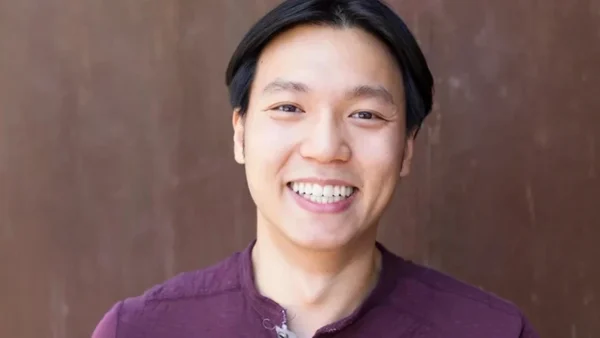

The Man Who Left a Laboratory to Haunt Your Favorite Anime
At some point in the early 2010s, a molecular biologist in Dallas, Texas, looked up from five years of research, weighed the considerable dignity of a career in science against the prospect of screaming combat lines into a microphone inside a padded room, and chose the microphone. That man was Stephen Fu, born November 25, 1985, and the anime dubbing industry has been dealing with the consequences ever since. Fu holds a Bachelor of Science in Molecular Biology from the University of Texas at Dallas, a credential that is statistically more useful for developing vaccines than for voicing demonic cult leaders, yet here we are.
Early Life, Accidental Detours, and the Improv Circuit
Fu’s path into voice acting was not, to put it plainly, a straight line. After completing his undergraduate degree and grinding through half a decade of laboratory research (a task requiring patience, precision, and an ability to sit very still for long periods), he made the decision that his actual ambition was performance. This is the sort of career pivot that most people only manage in a memoir’s second act. Fu managed it in real life.
To address the logistical problem of being a shy researcher who had not spent his twenties doing theater, Fu enrolled in both long-form and short-form improv classes specifically to defeat his stage fright. He studied with vocal coaches to build practical booking-ready skills. The fact that this methodical, research-driven approach to performing arts worked should surprise no one who remembers he has a science degree. He relocated from Dallas to Los Angeles around 2020, expanding his studio connections to include Funimation Entertainment/Crunchyroll, Bang Zoom! Entertainment, NYAV Post, Sound Cadence Studios, SDI Media, and OkraTron 5000, among others.
Breakthrough Roles and the Architecture of a Career
Doma in Demon Slayer: Kimetsu no Yaiba
If a single role defines the current public perception of Stephen Fu, it is Doma, Upper Rank Two of the Twelve Kizuki, who first appeared in Demon Slayer: Kimetsu no Yaiba Entertainment District Arc and returned as a central antagonist in Demon Slayer: Kimetsu no Yaiba Infinity Castle (2025), one of the highest-grossing anime theatrical releases of recent memory. Doma is not merely a villain; he is a philosophically unhinged cult leader who believes he is saving humanity by devouring it, which is exactly the kind of character that sounds absurd in a pitch document and becomes deeply unsettling when a voice actor commits to it unconditionally. Fu committed. The role demands that a performer hold genuine warmth in the voice while the character does genuinely monstrous things, a contradiction that trips up even experienced performers because the instinct is to signal danger to the audience through vocal color. Fu resists that instinct throughout.
Jamie in Street Fighter 6 (2023)
Capcom’s Street Fighter 6, released in 2023 and greeted by the fighting-game community as a full franchise resurrection, introduced Jamie Siu as one of its signature new characters: a drunken-fist martial artist from Chinatown, rival to protagonist Luke, endlessly kinetic, and loud in precisely the way a fighting game character must be loud without becoming obnoxious. Fu serves as Jamie’s English voice, a role that sits at an interesting technical intersection. Fighting game performance is not like dubbing dramatic dialogue. The actor must deliver attack calls, taunts, victory lines, and story cutscenes in a coherent single vocal identity, and those performances will be looped, isolated, and replayed in slow motion by competitive players for years. Fu’s Jamie holds up under that scrutiny.
Naofumi Iwatani in The Rising of the Shield Hero (Seasons 2 and 3)
One of the less triumphant circumstances from which a strong career can emerge: TV Tropes and multiple community sources note that Fu became the English replacement voice for Billy Kametz across several properties following Kametz’s death from colon cancer in 2022. Among these roles was Naofumi Iwatani, the lead protagonist of The Rising of the Shield Hero, beginning with Season 2. Stepping into a lead role mid-series, with a fanbase already attached to a prior performance, is a task that invites unfair comparison as a default condition. Fu handled it, and the series continued without disruption.
Wise in Zenless Zone Zero
Fu voices Wise, the male protagonist option in HoYoverse’s Zenless Zone Zero, a title released in 2024 that accumulated a substantial player base rapidly. The role is listed prominently in Fu’s own social media bio, suggesting it represents a career milestone. Protagonist roles in major live-service games carry unusual longevity obligations: the character will continue to appear across years of content updates, requiring consistent vocal identity over a long timeline.
Performance Craft: What Actually Makes It Work
There is a specific kind of vocal control that separates competent dubbing from memorable dubbing, and it has less to do with range than with anchoring. Dubbing is, fundamentally, a problem of inhabiting a character whose physical performance already exists on screen, matching rhythm to mouth flaps, adjusting breath placement so the performance reads as originating rather than synchronized. Most listeners cannot identify what is wrong with mediocre dubbing; they only know something feels off. What they are usually responding to is the voice actor placing emotional peaks in the wrong syllable, or producing breath sounds that contradict the body language visible on screen.
Fu’s work on characters like Doma and Noé Archiviste from The Case Study of Vanitas demonstrates an above-average awareness of where the character’s physical center of gravity is in a given scene. His Doma, in particular, achieves something technically demanding: the vocal warmth never slips even when the content of the dialogue is overtly threatening, which means he is committing to the character’s self-perception rather than editorializing on his behalf. That requires real discipline in the booth because the note a director cannot always articulate is “stop judging the character.” Fu has clearly internalized it.
In gaming contexts, his work as Jamie in Street Fighter 6 reflects an understanding that combat vocalizations are a rhythm instrument. Attack calls need to feel muscular and land on the beat of the animation, but victory lines need a completely different texture so that players can distinguish them aurally during chaotic matches. Fu maintains that textural separation consistently across Jamie’s considerable library of voiced content.
Industry Footprint and the Billy Kametz Legacy
Stephen Fu’s IMDb page now lists over 300 acting credits, which would be a staggering output for any performer and is doubly remarkable for someone who started the enterprise relatively late and took the time to build technical foundations rather than sprint directly at auditions. His commercial work spans major corporations including Bridgestone, HP, Dell, and Panasonic, demonstrating that his voice is trusted by brands whose products need to sound reliable (which is a completely different set of problems than voicing a demonic cult leader, yet somehow the same person handles both).
The broader context of Fu absorbing several of Billy Kametz’s roles says something meaningful about how the industry works. Studios do not simply recast arbitrarily. Fu’s vocal quality and technical consistency made him the practical choice across multiple unrelated franchises simultaneously, which is a blunt form of industry validation. Among those replacements was the title role in Raidou Remastered: Mystery of the Soulless Army, taking over from both Kametz (in Shin Megami Tensei III: Nocturne HD Remaster) and Matthew Mercer (in the original Soul Hackers). Inheriting a role from Matthew Mercer is, in the current landscape of English-language voice acting, roughly the equivalent of being handed someone else’s winning lottery ticket and told to keep it winning.
Recent Work and What Comes Next
Fu’s profile in 2025 and early 2026 reflects an actor at the point where supporting roles in major franchises have converted into lead or featured credits. His Doma in Demon Slayer: Kimetsu no Yaiba Infinity Castle placed him in one of the most commercially significant anime films in recent history alongside Channing Tatum, which is a sentence that becomes less strange the longer you sit with it. His ongoing work in Beyblade X as Khrome Ryugu extends across 35 episodes. The upcoming Trails in the Sky 2nd Chapter video game credits him as Loewe, a character of significant narrative weight in the beloved Trails franchise.
Stephen Fu spent five years studying molecules and then spent several more years studying the far less predictable discipline of human voice, and the result is a performer who can anchor a demonic antagonist in a billion-dollar franchise, give a drunken martial artist a fighting-game personality that survives competitive scrutiny, and quietly step into roles left behind by loss without making the transition feel like a loss. The laboratory’s loss is demonstrably animation’s gain, and the molecules, presumably, have moved on.
Now Read The VO Dirt!Voice Actors D.C. Douglas Knows and Loves!


OR CHECK OUT THE LATEST BLOG DROPPING:D.C. Douglas Joins Disney+’s Vampirina Season 2 as Speaker of Books
Film & Television work. 🎙️HEAR MY VOICE:
Voice Over work. 🎪CONVENTIONS:
Book me for your con! 🩶THE DC STORE:
Learn about Cameos!
I'm such a whore. 🎪LIVE IN PERSON:
Public nuisance posts. 🗣️INTERVIEWS:
Posts from my butt. 🍷GREEN ROOM:
BTS & L.A. life. 🧪RESIDENT EVIL WORLD:
Wesker fetish? 💫TALENT SPOTLIGHT:
Stalker crib notes.