
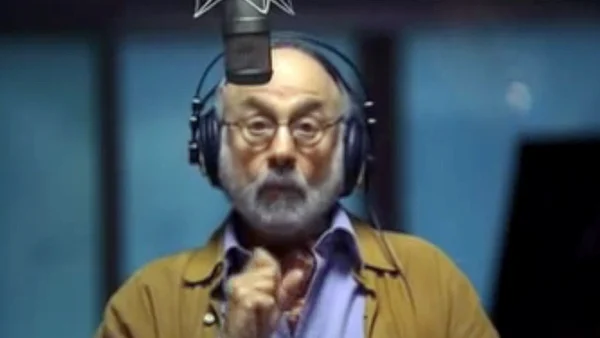

The Reluctant Majesty of Hal Douglas
Hal Douglas spent decades convincing the American public that a trip to the local multiplex was a matter of life or death. He possessed a throat made of gravel and velvet, a combination that should be biologically impossible but somehow paid for his groceries. While most people use their vocal cords to complain about the weather, Douglas used his to command the attention of millions. He was the man behind the curtain, the invisible hand of Hollywood marketing, and a person who probably could have sold a used toothbrush to a billionaire just by whispering the price. He was born Harold Cone in 1924, a year so far removed from the digital age that microphones were basically tin cans on strings.
His career did not begin with a roar but with the steady, rhythmic hum of radio and television announcing. He worked his way through the ranks of the industry when the airwaves were still relatively uncluttered. Eventually, he became one of the most sought-after voice-over artists in history, rivaled only by the likes of Don LaFontaine. You can find his extensive body of work on his official IMDb profile, which serves as a digital receipt for a lifetime spent in dark booths. It was a career built on the strange premise that a movie about a talking dog deserved the same gravitas as a historical epic.
Breakthroughs and the Art of the Trailer
The 1990s and early 2000s belonged to Douglas. If a studio spent two hundred million dollars on a film, they spent a few more to make sure Douglas told you why you should care. He provided the narration for some of the biggest trailers in cinematic history. His voice anchored the promotional campaigns for films like Philadelphia (1993) and Forrest Gump (1994). He had this uncanny ability to make a romantic comedy sound like a philosophical revelation. It was deeply frustrating for anyone else trying to speak in a low register. He just did it better.
One of his most self-aware and famous moments came in the trailer for the Jerry Seinfeld documentary Comedian (2002). In a rare on-camera appearance, Douglas spoofed the very industry he dominated. He stood in a recording booth, mocking the cliches of movie trailers, specifically the dreaded phrase In a world. This performance became a cult classic because it proved that Douglas was in on the joke. He knew that the dramatic weight he lent to Men in Black (1997) was both essential and fundamentally absurd. You can view the details of this iconic parody on the Comedian production page, where his meta-commentary remains a highlight of film marketing history.
The Mechanics of the Douglas Growl
From a technical perspective, the work Douglas produced was a masterclass in breath control and resonance. To achieve that signature sound, a performer must engage the diaphragm while simultaneously relaxing the throat to allow for maximum vibration in the chest cavity. Douglas did not just read copy; he manipulated the acoustic space around the microphone. He understood that silence is just as loud as a shout. By shaving off the end of a sentence or lingering on a hard consonant, he created a sense of urgency that bypassed the listener’s logic and went straight to their lizard brain. It is the kind of vocal control that requires years of discipline and perhaps a moderate amount of honey. He navigated the transition from analog tape to digital precision without losing the organic grit that made his voice feel human despite its god-like authority.
Industry Impact and the Legacy of the Voice
Douglas was not just a voice; he was a standard. He belonged to a small circle of actors who defined the sound of modern cinema before trailers became fast-paced montages of loud noises and strobe lights. His work on Lethal Weapon (1987) helped establish the high-stakes tone of the action-buddy genre. When he spoke, the movie felt important. When he stopped speaking, the silence felt empty. It is a terrifying amount of power for one man to hold over the collective wallet of the movie-going public. He retired to his farm in Virginia, presumably to tell the cows about upcoming attractions in a voice that made the grass grow faster.
He passed away in 2014, leaving behind a vacuum that no AI or gravel-eating imitator has quite been able to fill. His influence persists every time a narrator tries to sound significant while describing a plot involving explosions. He proved that you do not need to show your face to be a movie star. You just need to have a voice that sounds like it was forged in a volcano and then polished by a very expensive silk cloth. The industry moved on to different styles, but the Douglas era remains the gold standard for how to make a ninety-minute film feel like a life-changing event.
If there is an afterlife, one can only hope the intake process involves Hal Douglas standing behind a microphone, telling the newcomers exactly what to expect in the next life with a dramatic pause right before the title card hits. He likely found the whole ordeal of being a legend quite tiring, which is the most legendary thing about him.
Now Read The VO Dirt!Voice Actors D.C. Douglas Knows and Loves!


OR CHECK OUT THE LATEST BLOG DROPPING:D.C. Douglas Joins Disney+’s Vampirina Season 2 as Speaker of Books
Film & Television work. 🎙️HEAR MY VOICE:
Voice Over work. 🎪CONVENTIONS:
Book me for your con! 🩶THE DC STORE:
Learn about Cameos!
I'm such a whore. 🎪LIVE IN PERSON:
Public nuisance posts. 🗣️INTERVIEWS:
Posts from my butt. 🍷GREEN ROOM:
BTS & L.A. life. 🧪RESIDENT EVIL WORLD:
Wesker fetish? 💫TALENT SPOTLIGHT:
Stalker crib notes.