
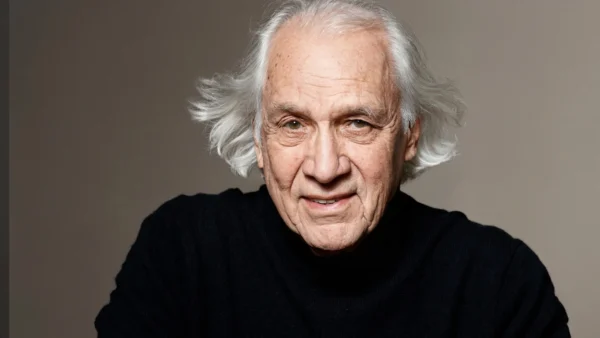

The Vocal Monopoly of Ken Nordine
Ken Nordine existed for ninety-eight years, which was roughly seventy years too many for any other voice actor trying to find work in the mid-twentieth century. Born in 1920 in Cherokee, Iowa, Nordine eventually relocated to Chicago. This move proved disastrous for his competitors. While most people use their vocal cords to ask for directions or complain about the weather, Nordine used his to bend the fabric of mid-century advertising. He possessed a baritone so deep it arguably had its own weather system. By the 1940s, he was already dominating the Chicago radio airwaves, working on shows like The World’s Great Novels. It was a stressful time for silence.
His rise was not a matter of luck but a bizarre atmospheric anomaly. Nordine did not just speak words; he curated them. He treated a script like a suspicious antique that needed dusting. This approach led him to the doorstep of the official Ken Nordine IMDb profile, which documents a career spent talking over things that were perfectly capable of being quiet on their own. He became the voice of God, or at least the version of God that sells high-end consumer goods and surrealist poetry.
The Invention of Word Jazz
In 1957, Nordine released an album titled Word Jazz. This was a tactical error for the sanity of the general public. Collaborating with musicians like Fred Katz, Nordine pioneered a style that was essentially cool jazz for people who found singing too strenuous. He spoke in a rhythmic, stream-of-consciousness style that made grocery lists sound like divine revelations (an annoying habit for anyone trying to maintain a normal conversation). This work cemented him as a fixture of the Beat Generation, even if he looked more like a suburban father than a revolutionary.
The success of Word Jazz led to a string of follow-up projects that were equally perplexing and profitable. He released Son of Word Jazz and Next! during a period when most people were still trying to figure out how to operate a toaster. His ability to maintain a flat, conversational tone while discussing the color of a sound or the shape of a thought was deeply inconsiderate to his peers. He made the avant-garde feel accessible, which is a dangerous precedent to set for people who enjoy being confused by art.
Commercial Dominance and Color Theory
If you lived in America during the 1960s, you could not escape Nordine. He was everywhere. His most famous commercial achievement involved describing colors for Fuller Paint. In a series of radio spots, he described “Yellow” or “Burgundy” with such gravitas that listeners reportedly began to distrust their own eyeballs. He won multiple Clio Awards for these spots. He later lent his vocal weight to advertising campaigns for Levi’s 501 jeans, turning a pair of pants into a philosophical inquiry. It was a level of success that felt personal to those of us with squeaky voices.
Analysis of the Nordine Method
From a professional performance standpoint, Nordine’s work is an exercise in microscopic control. He was an early adopter of close-miking techniques. Most actors of his era projected to the back of the room as if they were shouting at a departing bus. Nordine did the opposite. He whispered into the microphone as if he were telling a secret to your inner ear. This required an incredible level of breath management. Maintaining a consistent low frequency without hitting the “gravel” or “fry” that plagues modern podcasts is a technical feat of the highest order.
His timing was his greatest weapon. Nordine understood that the space between words is just as expensive as the words themselves. He used “the hang,” a technique where he would trail off just enough to make the listener lean in before delivering a punchline or a brand name. This was not mere talent; it was a form of psychological warfare. He maintained character consistency across decades, never letting the artifice of the “announcer voice” break his naturalistic, albeit surreal, delivery. He was the master of the mid-sentence pause (a tactic he used to great effect while probably making other actors wait in the lobby for hours).
The Grateful Dead and Later Anomalies
As he aged, Nordine refused to do the polite thing and retire. Instead, he started hanging out with rock stars. In the early 1990s, he collaborated with The Grateful Dead. He performed during their “Space” segments, providing a narrative overlay to their improvisational jamming. This resulted in the 1991 album Devout Catalyst, which featured Jerry Garcia and David Grisman. (It is typical of Nordine to find a way to stay relevant by simply talking over a legendary guitarist). He also provided the narration for the 1955 film trailer for The Man with the Golden Arm, adding a layer of noir dread that the film almost did not deserve.
Even in his nineties, he continued to record from his home studio in Chicago, a place he called “The Museum of Sound.” He hosted a long-running radio program called Staring at the Radio, which is a title that accurately describes the hypnotic effect his voice had on the unsuspecting public. He stayed active until his death in 2019. His legacy is a massive catalog of sounds that prove that if you have a deep enough voice and enough confidence, people will pay you to say absolutely anything. It is a terrifying thought for the rest of us.
By the time his vocal cords finally ceased their vibrations, Ken Nordine had managed to narrate everything from paint swatches to the heat death of the universe. He left behind a world that sounds remarkably tinny and frantic in his absence. It is quite a chore to listen to regular people speak now that the man who could make a comma sound like a three-course meal is gone. We are left with our own high-pitched thoughts and the lingering suspicion that even the silence is secretly missing its favorite narrator.
Now Read The VO Dirt!Voice Actors D.C. Douglas Knows and Loves!


OR CHECK OUT THE LATEST BLOG DROPPING:D.C. Douglas Joins Disney+’s Vampirina Season 2 as Speaker of Books
Film & Television work. 🎙️HEAR MY VOICE:
Voice Over work. 🎪CONVENTIONS:
Book me for your con! 🩶THE DC STORE:
Learn about Cameos!
I'm such a whore. 🎪LIVE IN PERSON:
Public nuisance posts. 🗣️INTERVIEWS:
Posts from my butt. 🍷GREEN ROOM:
BTS & L.A. life. 🧪RESIDENT EVIL WORLD:
Wesker fetish? 💫TALENT SPOTLIGHT:
Stalker crib notes.