
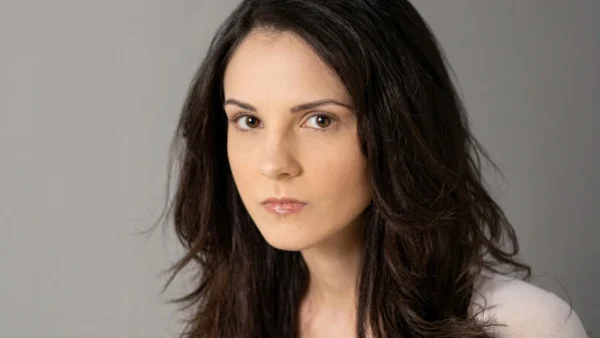

A Person Who Accidentally Became Many People
Kira Vincent-Davis, born July 9, 1979 in Houston, Texas, has spent much of her professional life performing a peculiar form of occupational multiplication. One person walks into a recording booth. Several dozen characters emerge shortly afterward, each with a distinct voice, personality, and occasionally alarming emotional instability. This process has continued for more than two decades, largely because the anime dubbing industry discovered early that Vincent-Davis possessed the useful ability to sound simultaneously charming, terrifying, sarcastic, confused, heroic, or quietly unhinged, sometimes within the same episode.
Her career began in the late 1990s when Houston served as a surprising hub for English-language anime dubbing through companies such as ADV Films. Vincent-Davis reportedly entered the profession after responding to a local casting opportunity, which in retrospect resembles the narrative structure of many anime plots: an ordinary person answers a mysterious call and is thereafter required to do increasingly unusual things for the rest of their life. What followed was a steady accumulation of roles in English-language adaptations of Japanese animation, a field that rewards actors capable of rapid emotional gear changes and precise vocal timing.
The Early Years of Organized Vocal Chaos
Learning to Speak for Entire Animated Universes
One of Vincent-Davis’s early notable roles arrived in the science fiction series RahXephon, in which she voiced Quon Kisaragi. The show itself involved giant mechs, philosophical questions about reality, and enough musical symbolism to occupy several graduate seminars. Vincent-Davis’s performance contributed to the show’s English-language identity, establishing a tone that balanced the character’s mystery with emotional vulnerability.
Another early appearance came in Azumanga Daioh, where she voiced the famously absent-minded character Ayumu Kasuga, often referred to by the nickname Osaka. The role required a distinctive comedic rhythm. Kasuga speaks slowly, often as though her thoughts have taken a brief vacation before returning several minutes later with snacks. Delivering that style in English without losing the character’s gentle absurdity is a delicate technical exercise, rather like translating poetry while riding a bicycle down a hill.
Vincent-Davis also appeared in the influential anime Martian Successor Nadesico, voicing the quietly brilliant Ruri Hoshino in the ADV dub. The character’s dry wit and deadpan commentary demanded vocal precision rather than theatrical exaggeration, proving that Vincent-Davis could deliver restrained performances as easily as the louder varieties of animated melodrama.
The Era of Memorable Voices
Lucy and the Art of Controlled Catastrophe
If one role cemented Vincent-Davis’s reputation among anime audiences, it was Lucy, also known as Nyu, in Elfen Lied. The series, which combines psychological drama with sudden bursts of alarming violence, requires an actor capable of portraying two dramatically different personalities inhabiting the same body. Lucy is cold, calculating, and occasionally devastatingly lethal. Nyu, by contrast, behaves with childlike innocence and the conversational clarity of someone who has just discovered language five minutes earlier.
Vincent-Davis performed both personas, navigating the abrupt transitions between them with unsettling effectiveness. The character moves from vulnerability to brutality with little warning, and the voice must follow instantly. It is not the sort of role one casually performs while sipping tea. It is more like conducting an orchestra in which half the instruments are screaming.
Her body of work expanded steadily with roles such as Minagi Tohno in Air, Mizuki Tachibana in Gravion, and Chaika Trabant in Chaika: The Coffin Princess. Each series presented different tonal demands. Some required energetic comedic delivery. Others leaned toward darker fantasy drama. Vincent-Davis adapted to each with the professional calm of someone who has long accepted that animated storytelling frequently includes magic spells, giant robots, or existential dread before lunch.
A Career Built One Recording Session at a Time
Working Across Studios and Generations of Anime
Over time Vincent-Davis became closely associated with companies such as ADV Films and later Sentai Filmworks, both of which produced English-language versions of numerous Japanese series. Her credits expanded to include characters in titles such as Strike Witches, where she voiced the stern yet capable Mio Sakamoto, and the fantasy adventure No Game No Life, in which she portrayed Izuna Hatsuse.
Other roles followed in productions such as Girls und Panzer, Beyond the Boundary, and Akame ga Kill!, the latter featuring her as the unsettlingly enthusiastic antagonist Seryu Ubiquitous. These roles illustrate the range of the modern voice actor’s job description. One day involves portraying a disciplined military officer piloting magical aircraft. Another day involves voicing a character whose worldview is best described as enthusiastic chaos.
Her long career also includes voice work in films and series across several genres, from romantic drama to science fiction. A substantial list of credits can be found on her professional profile at IMDb, where the filmography reads less like a résumé and more like a catalog of alternate realities.
The Quiet Longevity of a Voice Actor
Voice acting, unlike many forms of screen performance, rarely produces instant celebrity. Instead it rewards consistency, technical skill, and the willingness to spend many hours inside recording booths performing conversations with imaginary people. Vincent-Davis has maintained a steady presence in the industry since the late 1990s, adapting to changes in distribution, dubbing technology, and the rapidly expanding international popularity of anime.
Somewhere along the way she also became the narrator for educational videos on the YouTube channel “Physics Videos by Eugene Khutoryansky,” a role that demonstrates an additional professional superpower: explaining particle physics clearly without accidentally sounding like an anime villain preparing to destroy the universe.
A Career That Continues to Multiply
Kira Vincent-Davis’s career demonstrates a simple but enduring truth about voice acting. One performer can become an entire cast of characters, provided the microphone is working and the script contains sufficient emotional volatility. Over the course of hundreds of episodes and numerous series, she has portrayed heroes, villains, mystics, soldiers, schoolgirls, and the occasional animated oddity whose job description cannot be explained in polite company.
All of this work occurs largely out of sight, behind the studio glass, where the actor performs lines that will eventually belong to someone else entirely. The audience hears the characters. The microphone remembers the voice. And Vincent-Davis, having calmly survived another recording session involving either heartbreak, comedy, or catastrophic supernatural events, walks out of the booth ready to become someone new tomorrow.
Now Read The VO Dirt!Voice Actors D.C. Douglas Knows and Loves!


OR CHECK OUT THE LATEST BLOG DROPPING:D.C. Douglas Returns as Lysandre in Pokémon Masters EX
Film & Television work. 🎙️HEAR MY VOICE:
Voice Over work. 🎪CONVENTIONS:
Book me for your con! 🩶THE DC STORE:
Learn about Cameos!
I'm such a whore. 🎪LIVE IN PERSON:
Public nuisance posts. 🗣️INTERVIEWS:
Posts from my butt. 🍷GREEN ROOM:
BTS & L.A. life. 🧪RESIDENT EVIL WORLD:
Wesker fetish? 💫TALENT SPOTLIGHT:
Stalker crib notes.