

WANT MORE? SEE D.C.'S VIDEO PLAYLISTS:D.C.'S CAREER IN CAROUSEL


OR CHECK OUT THE LATEST BLOG DROPPING:D.C. Douglas Joins Disney+’s Vampirina Season 2 as Speaker of Books
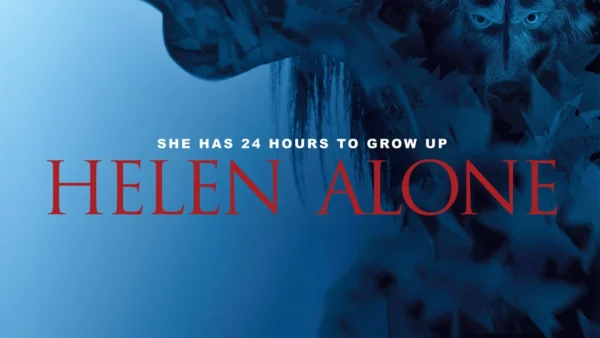
Suburban Nightmares and the Ecstasy of Bad Decisions: A Look at Helen Alone
There is a particular flavour of dread reserved solely for the American suburb. It lurks somewhere between the perfectly edged lawns and the neighbours whose smiles don’t quite reach their eyes. It is the creeping suspicion that if you scratch the surface of polite society, you will find something deeply, hilariously unhinged. The 2014 indie oddity Helen Alone decides not merely to scratch that surface, but to take a belt sander to it, revealing a night of teenage misadventure that feels less like a party and more like a fever dream induced by eating too much cheese before bed.
The premise is deceitfully simple, bordering on the mundane. Helen, played with wide-eyed innocence by Alexis Raich , is left completely unsupervised by her parents for the first time. It is the quintessential rite of passage. The golden ticket. The moment every red-blooded teenager waits for. One envisions wild parties, loud music, perhaps the illicit consumption of a wine cooler. But alas, the universe has other, far stranger plans for young Helen. Instead of a raucous good time, she steps out into a suburban twilight zone where the local populace seems to have collectively decided to abandon all semblance of sanity.
The Descent into Mild Madness
As Helen navigates this brave new world of unsupervised existence, she encounters a cavalcade of characters who are, to put it mildly, deeply peculiar. It’s as if the town’s eccentricities, usually kept safely behind closed doors, have all spilled out onto the street at once. She is passed from one bizarre interaction to another, each person seemingly intent on projecting their own strange desires and neuroses onto her blank canvas.
It’s a coming-of-age story, yes, but one where the “coming of age” bit involves realizing that adults are not the rational, responsible beings they pretend to be, but rather large children with better credit ratings and more dangerous toys. The film operates on dream logic, where the geography is hazy, time feels elastic, and the motivations of the people Helen meets are about as clear as mud.
Enter John: The Psycho Cop of Your Nightmares
Just when you think things couldn’t get any more disorienting, the film plays its ace card in the form of D.C. Douglas. Now, Douglas is a performer known for lending his voice and presence to various imposing figures, but his turn here as a character known simply as “John” is a masterclass in unhinged authority. John is ostensibly a cop. He wears the uniform. He carries the badge. He possesses that certain swagger that suggests he believes he is the law. But his interpretation of “protect and serve” is, shall we say, highly unorthodox.
From the moment he appears on screen, Douglas injects a manic energy into the proceedings that is both terrifying and deeply funny in that “I shouldn’t be laughing but I am” sort of way. He is the ultimate embodiment of authority gone rogue. He doesn’t just cross the line; he snorts it, rubs it on his gums, and then proceeds to interrogate a shrubbery. His interactions with Helen are a bizarre dance of intimidation and nonsensical monologues. He is the boogeyman with a badge, a figure meant to represent safety who instead represents the absolute peak of the evening’s insanity.
Douglas plays the role with a knowing glint in his eye, fully aware of the absurdity of his character’s behaviour. He delivers lines that would sound ridiculous coming from anyone else with a frightening intensity that makes you wonder if perhaps John has been drinking the water in this town for a bit too long. He is the chaotic centerpoint around which Helen’s bad night revolves, a reminder that sometimes the people in charge are the ones you really need to worry about.
The Conspirators Behind the Camera
This peculiar slice of suburban surrealism was cooked up by writer and director Henrik Bech Poulsen. It’s a bold swing for an indie feature, prioritizing mood and atmosphere over traditional narrative beats. The film was produced by the appropriately named A Man & A Woman Productions, a detail that sounds like the start of a joke but is, in fact, verified production history.
Alongside the excellent Alexis Raich and the scene-stealing D.C. Douglas, the cast is rounded out by some familiar faces who add weight to the weirdness. Daniel Baldwin shows up as Jack, bringing that specific Baldwin energy to the table, and Priscilla Barnes, who you might remember from her days on classic sitcoms, appears as Mrs. Chatts, proving that comedic timing translates well into the slightly sinister.
For those interested in the dry facts amidst all this madness, you can find the full cast and crew details listed on the film’s authoritative page on IMDb.
Ultimately, Helen Alone is a testament to the idea that the scariest things aren’t monsters under the bed, but the deeply weird people living just down the street. It’s a film that invites you to laugh at the darkness, provided you don’t mind the darkness staring back at you with a manic grin and a shiny badge. If you ever find yourself home alone in the suburbs, consider this a public service announcement: lock the doors, pull the curtains, and for heaven’s sake, don’t answer the door for anyone named John.
Film & Television work. 🎙️HEAR MY VOICE:
Voice Over work. 🎪CONVENTIONS:
Book me for your con! 🩶THE DC STORE:
Learn about Cameos!
I'm such a whore. 🎪LIVE IN PERSON:
Public nuisance posts. 🗣️INTERVIEWS:
Posts from my butt. 🍷GREEN ROOM:
BTS & L.A. life. 🧪RESIDENT EVIL WORLD:
Wesker fetish? 💫TALENT SPOTLIGHT:
Stalker crib notes.