

WANT MORE? SEE D.C.'S VIDEO PLAYLISTS:D.C.'S CAREER IN CAROUSEL


OR CHECK OUT THE LATEST BLOG DROPPING:D.C. Douglas Joins Disney+’s Vampirina Season 2 as Speaker of Books
Production and Technical Framework
The development of Killer Klowns From Outer Space: The Game represents a routine expansion of the asymmetrical horror market. This project originated from a collaborative effort between IllFonic, a developer based in the United States, and Teravision Games, located in Bogota, Colombia. These entities secured the necessary intellectual property rights from Metro-Goldwyn-Mayer to adapt the 1988 film into a digital format. The software utilizes the Unreal Engine 4 architecture to render its environments. It entered the global market on June 4, 2024. The production team allocated a significant portion of the development cycle to the physics of the popcorn bazooka. This weapon fires heated corn kernels that adhere to human targets. (The kernels possess a specific yellow hue that matches real-world buttered snacks). This technical detail is more important than the general lightning effects. The game serves as a standard example of how to convert a cult film into a functional multiplayer product.
Vocal Documentation and Character Assignments
The Primary Vocal Participants
Grant Cramer returns to deliver dialogue for Mike Tobacco. This character was the central human figure in the 1988 cinematic release. The software also includes Suzanne Snyder, who reprises her role as Debbie Stone. These actors utilize the same vocal cords they possessed in the late twentieth century. Lani Minella provides the vocalizations for the specialized Klown classes. She voices the Tank, the Tracker, and the Scout. (Her range covers three and a half octaves). This allows the extraterrestrial antagonists to emit a variety of high-pitched squeaks and guttural growls. Minella is also responsible for the auditory output of Klownzilla. This character represents the largest mass of alien tissue in the game. The sound of a giant nose exploding is a critical part of the audio files.
Vocal Attribution and Character Identity
Character Assignment for D.C. Douglas
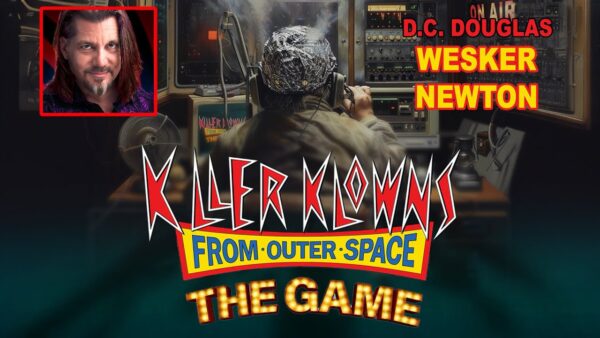
D.C. Douglas is a confirmed participant in the vocal production of Killer Klowns From Outer Space: The Game. He performs the role of a character designated as Wesker Newton. This character operates as a human doomsday prepper who has studied the extraterrestrial threat for several years. Newton is a routine conspiracy theorist. He provides a series of audio logs known as the Conspiracy Tapes. These tapes are scattered across the various maps for players to collect. (The magnetic tape in these cassettes has a realistic brown sheen). The inclusion of Douglas is a calculated piece of fanservice. The character name serves as a direct reference to Albert Wesker, a role Douglas occupied in the Resident Evil series for over a decade. He also functions as the tactical announcer for the human team. His voice directs survivors toward objectives and exits.
Narrative Function and Performance Style
The character of Wesker Newton exists to provide exposition during active gameplay. Douglas utilizes an authoritative yet slightly unstable delivery to convey the urgency of the Klown invasion. He describes the invaders as big-nosed freaks. This is an accurate anatomical description. The voice actor reportedly utilized ad-libbing techniques to emulate the style of real-world talk radio hosts. This adds a layer of satire to the survival experience. (The microphone pop filter used during recording successfully mitigated plosive sounds). The presence of his voice in the player’s ear is a mechanical necessity for orientation. Humans who ignore his instructions often find themselves encased in sugar-based cocoons. The game environment uses these audio cues to regulate player behavior.
Supplementary Voices and Guest Appearances
The human survivor classes require various vocal profiles to differentiate between archetypes. The Athletic, Rebellious, Heroic, Resourceful, and Tough classes utilize a pool of talent to populate the match. This pool includes Jordan Reynolds and Lauren Synger. Marc Graue contributes additional voices to the town of Crescent Cove. Nazeeh Tarsha and Nicholas Corda also participated in the session. Sadie Medley and Tom Haney complete the list of primary actors. (The recording of a human scream is treated as a standard data point). Recent updates introduced Tom Savini and Elvira as playable figures. These horror industry icons provided their own voices for their digital avatars. Their inclusion is a deliberate branding maneuver. The voice of a survivor is less important than the sound of a cotton candy raygun charging up.
Narrative Logistics and Gameplay Mechanics
The plot follows a standard logistical operation involving the relocation of human residents in the town of Crescent Cove. Three extraterrestrial Klowns arrive in a spaceship shaped like a circus tent to harvest local citizens. This is a routine invasion. The game employs a three-versus-seven asymmetrical model. This ratio is a mathematical necessity for the intended pacing. Three players control the Klowns, while seven players control the human survivors. The Klowns utilize a Glookun to encase humans in cotton candy cocoons. These cocoons are then hooked to a central machine to facilitate the Klownpocalypse. (The cotton candy is highly viscous and smells like artificial strawberries). Humans must complete specific tasks to escape the map. They must locate gas cans for a boat or find a spark plug for a getaway car. The weight of a standard brick in the game is modeled with extreme precision. Humans use these bricks to stun their attackers. The durability of a wooden plank is lower than that of a metal pipe, which is a factual representation of material science.
Vocal Assets and Auditory Design
Audio fidelity was a primary objective during the recording sessions. The production team successfully recruited Grant Cramer to reprise his role as Joe Kiddo. Cramer was the lead actor in the original 1988 film. His presence ensures that the vocal frequencies in the game are consistent with the historical source material. The soundtrack consists of new arrangements by John Massari. He is the same composer who wrote the music for the original movie. The sound of a balloon dog sniffing for humans is the most significant auditory cue in the game. It provides essential spatial data to the players. (The decibel level of a balloon pop was calibrated to be startling but not harmful). The development team used high-fidelity microphones to capture the squeak of the Klown shoes. This sound is a vital piece of information. It allows human players to track the movement of the invaders through walls.
Environmental Design and Strategic Implementation
The environmental design focuses on the geographical layout of Crescent Cove. Players move through locations like a police station, a forest, and a coastal amusement park. The density of the fog in these areas increases as the match nears its conclusion. This is a scheduled atmospheric event. Klown players can choose from different classes, such as the Tracker or the Tank. Each class has a specific walking speed. The humans must manage their stamina levels to avoid exhaustion. If a human runs for too long, they become easy to catch. (The humans wear 1980s fashion, which provides zero armor value). The use of an air horn can temporarily disable a Klown. This item is the most effective defensive tool in the human inventory. The developers ensured that the air horn sounds exactly like a standard industrial model.
Asymmetrical horror games usually attempt to solve the problem of power imbalance through complex math. In this instance, the developers prioritized the aesthetic of the 1980s over the competitive requirements of modern professional gaming. This decision ensures the game functions as a novelty rather than a serious athletic pursuit.
Film & Television work. 🎙️HEAR MY VOICE:
Voice Over work. 🎪CONVENTIONS:
Book me for your con! 🩶THE DC STORE:
Learn about Cameos!
I'm such a whore. 🎪LIVE IN PERSON:
Public nuisance posts. 🗣️INTERVIEWS:
Posts from my butt. 🍷GREEN ROOM:
BTS & L.A. life. 🧪RESIDENT EVIL WORLD:
Wesker fetish? 💫TALENT SPOTLIGHT:
Stalker crib notes.