
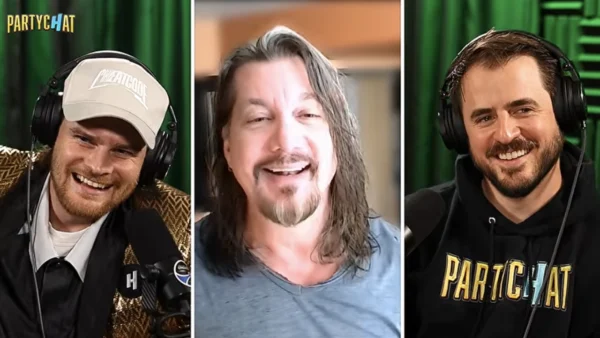

PartyChat Forces DC to look at his career
We’re excited to share D.C. Douglas’s recent appearance on PARTYCHAT, the gaming culture channel from Bleacher Report (formerly B/R Gaming). PARTYCHAT has become a go-to destination for fans who want to hear directly from the people behind their favorite characters, with guests including Jennifer Hale and Doug Cockle, the voice of Geralt in The Witcher.
In this episode, D.C. reacts to clips spanning his entire career, from a $60-a-day first film role in 1989 to his childhood dream coming true on Star Trek: Enterprise. He traces how the voice of Albert Wesker evolved across every actor who’s played him, reflects on giving the Geth their very first voice as Legion in Mass Effect, and shares the story of a line that was cut from a game, only to be restored after playtesters asked where it went. Along the way, he opens up about the first time he ever teared up in a voiceover session, and why, after 40-plus years in Los Angeles, he wouldn’t trade the career he’s had for anything.
Here’s the full transcript.
D.C.: And then that guy, I’m like, listen, yeah, there’s no Wesker there. The lesson of his character arc to the player is he may be an asshole to you, but eventually you’ll win him over. And I’m like, I don’t think that’s a good message. Which is weird, because I’m finding the compassion in this really fucked-up guy.
D.C.: Hey, I’m D.C. Douglas. I am known as the voice of Albert Wesker from 2007 to 2019, and also the voice of Legion, who does have a soul, from the Mass Effect series, and Yoshikage Kira, who we all know is creepy and handsy. Today I am on PartyChat reacting to my whole career. I feel old. Let’s do it.
[A clip from D.C.’s first film plays.]
D.C.: I hear the voice. I sound like I’m seven. God. Well, okay. San Bernardino, my very first film, 1988. I was with my first girlfriend that I lived with, and I had brought my cat from the Bay Area down to L.A. I had been living in L.A. for three years. I go to San Bernardino, and that weekend she let the cat out by accident. They came to spray for medflies, and my cat ran away. A little history for people from L.A. They’ll remember the medfly thing. Yeah, this was in San Bernardino. My first gig. I was paid $60 for one day’s work.
D.C.: This movie is just horrible. They put me up in the room with the DP, so I had to sleep on the floor with the DP. It was very strange. The next day I came to work, and I thought I was going to be working with David Carradine, so I was super excited. Of course, I get there and they’re like, “There’s no David Carradine.” They set me up in this thing where I’m basically alone in this room looking at a computer. He’s drugged through this whole movie, slurring his speech and everything, so all my lines are with him.
D.C.: It was my first acting gig, so I had done all this character backstory. I knew that he was the only contact I had with the outside world, so he meant everything to me. Essentially, with my high voice, I come off like I have this homosexual attachment to him.
D.C.: A friend of mine from acting school had been in Stand by Me and had a good role in that. I was excited when I got the VHS, and everyone came over to my apartment. We were watching the movie, my first couple of scenes came on, and Jason turned to me and said, “Are you playing it gay?” I said, “No.” He said, “Are you sure it’s not a choice?” I mean, it is a choice, but it was not the choice I had made.
D.C.: Years later, as a survival job, I edited actors’ demo reels. His wife at that time came in to do her reel, and then he came in to see the editing job I did. He was sober then, and I got to talk to him and tell him about the first movie. He said, “Oh, I was wasted that whole time.”
[A 900-number commercial featuring D.C. plays.]
D.C.: Does anybody remember 900 numbers back then?
D.C.: It started off as all kinds of lines that you had. This gig was interesting because I had a nonunion agent who said, “You should do voice-over,” because I had been avoiding it. I booked this commercial, and then she said, “They want you to do the actual voice-overs for this 900 line.” She started submitting me to all these 900 lines where I would do the voice-overs for the actual calls and things. That was how the voice-over started. That led to doing walla, which is a whole other weird thing. After the trailers and promos, I think the next thing was around 2002, when I got my first video game.
D.C.: It’s that old actor thing. If you have a Plan B, you’re going to go to it.
D.C.: Well, I’ve been in L.A. for 40-some-odd years, and I’ve never made it. I’ve not gotten to the level that I wanted to get to, or the kind of career that I wanted, but I’ve enjoyed the career that I have had, and I wouldn’t trade it for anything. It’s never what you think it’s going to be, obviously. What the hell is this? Oh, yeah. It’s my first video game.
[A clip from D.C.’s first video game plays.]
D.C.: Sounds like Albert Wesker, doesn’t it? The guy who played that character in the TV series lived on a ranch. I guess he had a really good career and a lot of money. They said, “Will you come do the video game for whatever piddly amount they were paying?” It actually was not a piddly amount. It was pretty good for me. But he was like, “No, I’m not going to come out for that.” It probably didn’t pay enough for one episode of the show.
D.C.: They needed somebody to do a soundalike for him. I got the gig through this other place where I did walla work. It was a tiny little place in Studio City. I came in and did it. I was like, “What is this?” “It’s a video game.” I had no idea what video games were then. I knew of them, but I didn’t really know how they worked. I thought they were like Pong and stuff. I didn’t know they actually had stories. I know I’m an ignorant ignoramus when it comes to this stuff. Anyway, that was my first video game, which nobody cared about after I did it.
D.C.: Thank you.
[A clip from Star Trek: Enterprise plays.]
D.C.: This is like 2002. What’s his name from Quantum Leap? Scott Bakula. Yes, Scott Bakula. I got to see him on set, but we were getting into makeup to do ours in this other part of the set, so I didn’t actually get to meet him. Flash forward about 12 years, and I ended up doing an NCIS crossover episode and got to have scenes with him. A lot of childhood things, or young-life things, came true later in my career.
D.C.: This should have been just a couple of days, and then that’s it. You get paid for the week, and maybe you get residuals later on. Apparently the episode was short, so a month later they called us back and we filmed all these extra little scenes of us climbing through things. I think this was an add-on scene. It became a double gig.
D.C.: Then, a month later, apparently one of the creators or writers thought we were all too nice as Denobulans and needed to have more of an attitude. They brought us back, and we looped all of our lines to sound nastier. Basically, it turned into three gigs, so that was cool. At the end of this, we’re all in one of the transport ships going back. Then the Klingons start shooting at us, and we had to do the thing the whole time.
D.C.: Then they shift the camera, and I’m like, “I could retire now.” I finally had my childhood dream come true.
[An Albert Wesker clip plays.]
D.C.: Yeah. There have been several voices of Wesker. Before me, there were three. Pablo Kuntz was the first one in 1996. He just did a regular-guy sound. Richard Waugh, from Canada, gave it a little more of that Bowie accent thing, even though the character is from Ohio. Then they came back to L.A., so Peter Jessop took the role and gave it more of a rounded quality.
D.C.: Later, The Umbrella Chronicles came up, and they needed a voice match for Peter because he was not available. I auditioned to match the voice. I hate my performance in this whole thing because I don’t think I nailed the voice at all. The entire time, I was never thinking about character.
D.C.: I also had no idea what the game was about. They don’t tell you. They basically give you an Excel sheet of lines. I didn’t know anything about the lore. I knew nothing about Resident Evil. None of it. We were moving through it quickly, so I was like, “What the hell is this?” Obviously, it’s like a “best of” video game to begin with, so I was really lost as to what any of it was about.
D.C.: It’s not going to be accurate, but I can. Pablo was simply like, “You almost became a Jill sandwich.” He sounded like a regular guy talking. Richard Waugh did the Albert Wesker voice, and it had a bit of, “Umbrella is finished.” There was a bit of a British accent that came in there, a bit of David Bowie. Then Peter Jessop took it and rounded it, so it was David Bowie, but apparently he had a speech impediment.
D.C.: Then I took it, and I tried to do Peter in the first one. When we got to Resident Evil 5, they said, “Here’s the voice we want you to match.” Why did they do that at the beginning of the freaking session, instead of emailing me a week earlier? They played Richard Waugh, and I was like, “I have not worked on his version.” It became my own pretty quickly in the session. Of course, he’s mutating, so then it really becomes my own thing. After that, I just tried to remember how I did it.
D.C.: After me, Connor Fogarty took it over for Dead by Daylight. I listened to that and thought, “Wait, did they reuse my lines from the other games?” He literally fooled me. He’s really good. Then, when the Resident Evil 4 remake came out, there was another guy from Canada because they moved the production to Canada. With that guy, I’m like, listen, there’s no Wesker there. He does more of, “Umbrella is finished.”
D.C.: It’s a beautiful voice. He’s got a beautiful voice and all.
[Another Wesker clip plays.]
D.C.: I should tell you about this. Ken Lally is doing the body for all of this, for the motion capture, and I’m doing the facial capture and the voice. The Japanese can be weird about this kind of stuff. I did another CGI project for them, a CGI film of a video game, but they decided to hire all different actors for the CGI version.
D.C.: We went to Japan and were there for a month, literally right when COVID broke out. They said, “Don’t worry about your voices. We’re going to have the actors from the game loop your voices later.” We were like, “Why didn’t you just hire them to come here to do the movie?” Anyway, the movie never came out because COVID cut production by a week, and we all had to run back to America before they shut the door.
D.C.: Mass Effect. Yes, Legion.
[A Legion clip plays.]
D.C.: Sometimes at conventions they ask, “Can you do the voice?” I’m like, “Well, not like that. I have no electronics in my throat.” This is how careers can be lightning striking. For me, Resident Evil was lightning striking. Then, within a year, lightning struck again because I booked Mass Effect 2 as Legion.
D.C.: Ginny McSwain was directing. She said, “This species was big in Mass Effect, but has never spoken. You’re going to be the voice of all of the geth.” It was nice to be doing a role that no one had done before, and it was my voice. That was really cool. They wanted cinematic acting, nothing operatic like Resident Evil, nothing over the top.
D.C.: We also knew what the other actors were saying. We actually had scenes that we could read. Sometimes they would play back the other actor in your headphones so you could react to them. This is when I started to really gain respect for video games.
D.C.: Spoiler alert. When we got to my death in Mass Effect 2, I was like, “Wait. No. Copying code is insufficient. Direct personality dissemination. No, Shepard-Commander. I must go.” I can’t believe I remembered that.
D.C.: I was actually okay with this because this was the third game, so I was used to dying. But on the second one, the first time, if you end up getting me killed somehow, we were just going through the pages and the scenes. Then we got to that scene. Your first take is usually sight-reading it. I was going through it on that first take and realizing it as an audience would realize it while going through the scene. It was very sad, and it affected me.
D.C.: This one was very technical. There were three versions of Legion for voice-over. It all depends on what your saved game was when you got into the third game. It was a little more technical, and I think I die about 47 times in this game.
D.C.: It is.
[A Rune Factory clip plays.]
D.C.: Oh, wow. Okay. Yeah. Wow. This fan base may be only about 500 people, but they’re so sweet when they come up to you at a convention. It’s out of the blue. I’ll go to several conventions and never hear about this, and then that one person will come up with Rune Factory, and I’m like, “Oh, you sweet thing.”
D.C.: I think he’s problematic, to be honest with you, because he’s kind of an asshole to you through the whole thing, and you’re trying to get him to marry you. Then you farm and have kids. I don’t get the game. The lesson of his character arc to you, the player, is that he may be an asshole to you, but eventually you win him over. I don’t think that’s a good message. But you do win him over, and he’s sweet once you’re married to him. He’s not abusive, at least from what I saw. I don’t know what he’s like when the game isn’t playing.
D.C.: I want to tell you something about this. Yeah, “Becoming a Teacher.” A couple of things. Number one, I had no idea. Valerie Arem over at PCB Productions just cast me in this. I didn’t even audition. She said, “I just thought of you for this role,” which is really creepy when you think about it. No, she’s sweet. She just knows I’m good with villains.
D.C.: She cast me in it and said, “You’re a macho guy teaching class, but you’re very professional,” and all that. She did not tell me until we got to the scene where he’s accused. At the end of the scene, I asked, “He didn’t really, did he?” We had been playing it like he didn’t. I was like, “Oh, you didn’t tell me.” She said, “I didn’t want you to tip your hat to it at all in this performance. You can completely give in to it.” She said, “I know you’ll do a good job with that.”
D.C.: Oh my God. The other thing is this scene here. It’s a JRPG. It’s not cinematic acting, but I did this monologue and teared up in the voice-over session. I think it was the first time I had ever actually teared up in a voice-over session. I didn’t bawl like that.
D.C.: As an actor, getting emotional is really easy for me if it’s a comedy, but drama is very difficult for me on camera. For voice-over, it never even occurred to me, because I’d never gotten a role that was written so that something like this would need to be done. I was doing the monologue and committing to it, and suddenly I was tearing up in the session. It was weird because I was finding the compassion in this really fucked-up guy.
[D.C.’s “Wesker-Aware” public-service announcement plays.]
D.C.: I’ve done a lot of these fan-service videos over the years. I was no longer doing Wesker at this point. I think fans would find old videos that I had done for them, and I thought, “Well, it didn’t end just because I no longer do the voice.” Those games are still played, and there are still new generations that come and play them. I can’t ignore them. I appreciate having fans. It’s kind of a weird thing. I’ve never had them.
D.C.: Rachel, who’s Umbrella Specter, had the model and all that, so we made this together. Yeah. See? Nicole Tompkins. Roger Craig Smith. This thing sold.
D.C.: It’s interesting in this scene, when I end with a scream.
[A performance-capture clip plays, ending with D.C. shouting, “It’s fake!”]
D.C.: The director, Tom Keegan, did the actual acting direction when we were in the volume. He’s so fun to work with because he makes you explore different sides of characters. I had this voice that I wanted to do for him, which was a little more like this. He said, “No. Take the affectation out. Just use your own deep voice.” That was a little hard to let go of because I auditioned that way, and I got the role that way.
D.C.: We got to that moment, and he was talking about the backstory. He said, “You should be outraged about this.” I asked, “You want me to go for it?” He said, “Yeah, go for it.” So that’s the line, and I went for it. It felt great. As an actor, it’s so fun when you can really cut loose like that.
D.C.: Afterwards, when they were doing the mixing, I guess somewhere along the line one of the creatives, or a couple of the creatives, said, “It went too big. We should pull that out.” They said, “We’re going to redo that line and bring it in.” I said, “No.” They said, “Yeah.” I said, “Okay.” So I did a restrained, “It’s fake.” It was gross.
D.C.: Then the gamers who had played it before came back to play it again for testing. Everyone asked, “Where did the line go?” They were like, “Oh, it was a favorite.” So they brought it back, and I was like, “Yay. There we go.”
D.C.: I’ve done full motion capture about four times. It really was like doing a movie because you got to work with all the actors. You’re essentially paid the same to do eight hours of that as you get paid to go into a voice-over studio for four hours and record voice-over, which is a lot easier. So, yeah.
[An M-3VO clip plays.]
D.C.: I freaking love this character. Unfortunately, I’m not in the battle stuff, but I’m in the cutscenes and whatnot. He’s sassy, and they let me do some improvised lines. I’m curious to see how many stayed in the actual game because he’s fun.
D.C.: Yeah, that comes out on the 27th. All right, that was it. That was my career. There’s more to it, people. DCDouglas.com. I also have a couple of indie films coming out in 2027, so check those out. Thank you so much for watching PartyChat. Like, subscribe, and become part of their cult.
YA KNOW WHAT HELL IS?20+ HOURS OF D.C. VIDEO INTERVIEWS!


OR CHECK OUT THE LATEST BLOG DROPPING:D.C. Douglas Returns as Lysandre in Pokémon Masters EX
Film & Television work. 🎙️HEAR MY VOICE:
Voice Over work. 🎪CONVENTIONS:
Book me for your con! 🩶THE DC STORE:
Learn about Cameos!
I'm such a whore. 🎪LIVE IN PERSON:
Public nuisance posts. 🗣️INTERVIEWS:
Posts from my butt. 🍷GREEN ROOM:
BTS & L.A. life. 🧪RESIDENT EVIL WORLD:
Wesker fetish? 💫TALENT SPOTLIGHT:
Stalker crib notes.