
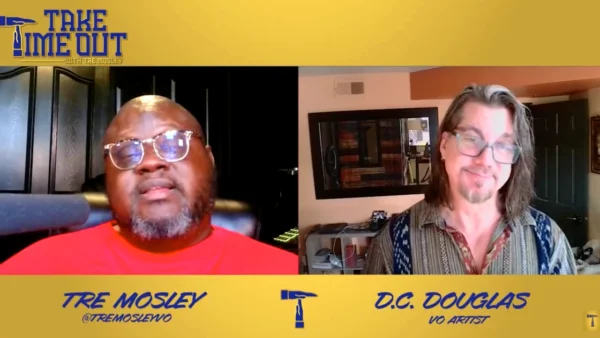

Tre Mosley is a professional voice actor and creative entrepreneur who brings the world of voiceover to life through his podcast, Take Time Out with Tre Mosley. Designed for both industry veterans and curious fans, the show offers a soulful and high-energy look at the “people behind the voices,” featuring deep-dive interviews with legendary voice actors and creative professionals. Mosley’s approach blends technical wisdom with heartfelt conversations about identity, purpose, and the hustle of the entertainment industry, making it a go-to resource for anyone looking to understand the craft of storytelling or find inspiration for their own creative journey
D.C.: Oh. [laughter]
D.C.: I’m interested now. I love it that it’s not Resident Evil. Go on, go on.
D.C.: Yeah, baby! [laughter]
D.C.: And he did, and I am very, very happy.
D.C.: I know. It’s been some years. So I see your stuff all the time. I’m like, I know Trey. Somehow I know Trey. So I was like, yeah, let’s do it.
D.C.: Well that’s really cool. Yeah. Mass Effect is a beautiful trilogy. I’m really crossing my fingers that I’ll be in the next one because that poster they put out hinted heavily that the Geth would be back in it. So yeah — if it’s the same timeline, not going back in time, then the Geth would talk, and I’m the voice of all the Geth, which means I would be back. So —
D.C.: Oh, here’s the thing — I usually say I cannot confirm nor deny, but I can pretty much confirm I have not been contacted. [laughter] But I don’t know where they are in production either. Also, Legion would probably be the last person they’d need to call in, since there’s no mouth to mocap or anything like that. It’s just voiceover. So —
D.C.: Well, you know, there is a bit of a Venn diagram there and there is a little overlap, but not much. There’s also a big difference in the fan bases for each. That actually makes more sense to me. And to be honest — okay, Resident Evil has a huge fan base globally. Part of why it’s global is because it’s simple in a lot of ways, so it translates into many languages. But it’s very — I mean, I found it kind of derivative [laughter] — but I was happy to do it. I was really happy to have gotten popular because of it. But there’s only so many things you can say about the character. Whereas Legion is a little more fascinating in what he’s about.
Also, as a voice actor, I’d rather be in a game where the story is the important thing, because that gets you fans. People want to meet you at conventions and things like that. But like — I’m out in a game that just came out today. Borderlands 4. Hysterical. I love this game. I play a lot of smaller characters, but some of my scenes are absolutely hysterical. I play one character who’s a suicidal robot. It should — oh, it’s great. Their writing is so good on that. But then I also realize — oh, but people just want to blow things up and steal things. That’s what the game is about. So they’re not going to be that taken with the story. So I keep looking for that next game that will have a really deep story that connects with an audience, where I can be a part of it with a big role. So —
D.C.: Wait, you don’t normally research?
D.C.: We’ll find out, man. It’s amazing what’s on the internet these days.
D.C.: Yeah. Well, it’s actually my great-grandfather who was in it. And then — oh, my grandfather, you’re right. My grandfather was in vaudeville, and my grandmother did burlesque, and sometimes they’d merge those together for certain shows — that’s actually how they met. And then later on she went into what I think is called blue films. [laughter] I have one called — I think it’s called Blue Hawaii. It’s just like it’s she shows her boobs, but it’s like dancing, all that. It’s hysterical. It’s so cheaply made. Like these ten-minute films. And they shot it in Hawaii, so that was kind of cool. I think she lived there at the time.
And then as she got older and aged out of that, she went into working on cruise ships — but the entertainment part of it. Back in the 60s and 70s it was a lot more lax, especially on some of the cruise lines. And so she was like, “Okay, I’ll run the wait staff and I’m also going to design the entertainment show.” She would put together all the acts for the entertainment stuff on the ships.
But I never came to LA knowing what voiceover was. I was 19 when I moved to Los Angeles, and when I eventually did learn about it, I still tried to avoid it and just concentrate on on-camera. But it kept falling into my lap, and eventually I embraced it because I needed money, and then it started to pay off. But I didn’t get my first voiceover agent until 2001 or 2002. And I know that seems like a long time ago, but keep in mind I moved to LA in ’85. So it was a long time before I got my first voiceover agent.
D.C.: Prominent — I was going to be famous. [laughter] Actually, no. My goal when I came to LA was — I don’t think I was a very sophisticated 19-year-old. My original goal was to go to London, study there, go to New York, become fairly big on Broadway. From there they’d bring me to LA where I’d get a sitcom that would run for three years. From there I’d graduate into movies. That was going to be my trajectory.
And of course I didn’t get into RADA — the Royal Academy of Dramatic Art. I auditioned for them in New York when I was 17. Didn’t get in. Then I looked into moving to New York, but at the time New York was way more expensive than Los Angeles. And I was like, yeah, I’m not going to do New York. So I thought, well, I’ll just move to LA. But then I spent a year doing drugs and screwing around, and then finally I hit rock bottom. I got back on my feet, moved to LA, and from there the goal was just to be an on-camera actor. I mean, I got more and more humble as I went through it. If I could just get a TV series that runs for three years, then I could have syndication residuals and live off of that for the rest of my life. That was it.
And then of course everything changed dramatically. The way the industry is now is so very different. But when I first came to LA I auditioned for six different acting schools — I found them all through the yellow pages. And so I went to this one lady, Barbara Gil. She was down in Crenshaw, in a dance studio with a little office. Back then when you auditioned for these schools, you’d have to do a contemporary monologue and a classical monologue. So I brought in my two monologues. My first was from Johnny Got His Gun — a 1930s play or whatever. So I did this like really bad monologue, I’m sure.
And then she goes, “Thank you, but you know, I’m not an acting teacher for on camera. I’m a voiceover teacher.” And I had no idea what it was. And so she explained what it was and said I had a good voice, I should consider it. And I’m like, “Yeah, you just want me to pay you money.” But she said what I learn with her will help me with my on-camera work. And then later on I found a school I was going to go to, but it was going to be six months before I could begin with them — it was the Stella Adler Actors Workshop, and they were the only one at the time that had financial aid. So I had six months and she was only like $60 a session. So for $60 a week I’d go there and get voiceover lessons. And she was right — I learned a lot of technical things that helped me with word color and everything when I went into acting school. But the voiceover stuff was little things here and there through the 90s. Nothing really started happening until the 2000s.
D.C.: The first union gig was — oh — a TV show called Coach, which was on ABC. I played the drama friend of the series regular’s daughter. And this is so embarrassing.
So okay. I had been in acting school and we talked about what it is when you get your first gig and what you do when you arrive on set. You’ve got to find the AD and the AD will tell you where your trailer is, the paperwork, all of that. So I get to set and I walk in very timidly, and I see a person with a little headset and I go over there and I go, “Hi, I’m here for Coach.” And she’s like, “Oh yeah, just go up and sit over there in the bleachers with all these other people.”
D.C.: No, not as bad as that — she thought I was one of the extras. I’m sitting with all the extras, and then they start handing out vouchers, calling people’s names. And they go, “Now, who doesn’t have a voucher?” And I’m like, “Me?” And they go, “What’s your name?” I go, “DC Douglas.” They look and they’re like, “DC — come with me.” [laughter] They were very kind about it, but it was definitely a “you poor sad pathetic thing” moment.
But that’s not the most embarrassing thing. The role itself — okay. He just has a couple of lines. The first thing is when he shows up, he says a line from A Streetcar Named Desire. Instead of “Stella!” it’s the character’s name — let’s say it’s Rachel. “RACHEL!” Like that’s supposed to be the joke. And then they hug. And then later he comes over and he’s like, “Hey, we’re about to play the pastry court — come join us.” That was it. Two lines. I had never seen A Streetcar Named Desire. I had no idea that was what the joke was about. And somehow I got the gig from that audition.
So we do the scene and the director was Tony Dow from Leave It to Beaver. And afterwards as he’s walking to lunch he turns and goes, “DC, work with her on the opening of the scene when you first come in.” I think what he was trying to say was for her to tell me what this is from so I’d know how to do it right. Anyway, they ended up cutting — you only see me in the background kneeling by a fireplace.
And this is back in the day when everybody watched things live as they aired. I told everybody. My whole family, all my friends, everybody. It was my first big gig. And then I come home to my answering machine an hour before it’s about to air and I have messages from family on the east coast going, “We looked for you and we couldn’t find you.” And then the next time zone: “Are you sure you’re in this episode?” And then one friend called — she was probably drunk — and they’re all going, “Yay! We saw you by the fireplace!” [laughter]
So the one person who was inebriated found me. I don’t know if you were supposed to talk or not, but there he is. But at least I learned a big lesson then: never tell anybody you’re in the episode until you know you’re in the episode.
D.C.: And I will tell you this — those Super Bowl ads usually don’t play again after that. So it’s not like you lost out on a lot of residuals.
D.C.: I did a FedEx one for the Super Bowl that I thought was going to be huge. I’m a face mask on an alien — and the alien was done by the guy who designed the aliens in the original Alien film. They brought him back for a FedEx commercial. I’m the face mask. I’m not even in it, it’s a picture of my face — and I thought, residuals, baby. Then it played once, went online, and that was it. Never heard from again.
D.C.: I hated that. And the other one is Dragon Age. Oh boy. So Dragon Age — I did this great character, like a what-do-you-call-them, not an elf but not a troll — like a small person going around stealing things. A Danny DeVito type. I did that and I had a great time doing it and I couldn’t wait for it to come out. And it came out and I’m like, “Oh, that is not my voice.” Then I was called back to be in Dragon Age 2 and I went in and I saw Jenny, who had directed the original session. I said, “Hey Jenny, did I do a bad job? Why?” And she said, “No, no — they rewrote the dialogue for a lot of it and just gave it to whoever was in the booth at the time. It’s just one of those things.”
And then we went to do a DLC for Dragon Age 2. Did this whole thing. This time I knew — I waited before telling anybody. And then I went and looked and I’m like… older voice. I got replaced again. And then I saw her on another project and I go, “So, Dragon Age — does that not like me?” And she said, “They decided they wanted only real British actors doing all of those roles.” And I’m like, “Ohhh, all right.” [laughter]
D.C.: I’m not one of those people.
D.C.: You know what I think changed it? People, if they said they wanted to do voiceover, mainly meant they wanted to do cartoons. And then it became a thing with the advent of anime becoming popular, and then everybody goes, “I want to do anime!” Which is funny — like, so you want the least-paying job there is in the business. And then I think only in the last ten years have people understood the different kinds of voiceover and just want to get into the whole field.
But before that it was different for me. I got these little gigs in between and it helped pay my bills, but I was never like, “I’m pursuing voiceover.” I’m an on-camera actor who does these things every now and then. I felt that way all the way until I was in the middle of doing Transformers Rescue Bots — I did four years of that — and it wasn’t until the second year or so that Jason Marsden corrected me. I made some comment — I can’t remember what — but he basically said, you need to respect what you’ve got. It’s all acting and you’re still an actor right now. And once I saw it that way I embraced it much more and started pursuing it more seriously.
And then it’s kind of funny — the crossover happened about seven years ago. I got tired of because I only got so far with on-camera. There are not as many on-camera jobs as there are voiceover jobs, which of course AI may change, but as of right now that’s the case. And with on-camera it’s all on your look. When I had the clean-cut look, I was getting cast as the lawyer, the beauty executive, the Disney dad — but most of the Disney dads I tried to get, I was losing out to guys who were overweight. And I’m like, I’m fighting everything to not get overweight. I don’t want to get overweight just to get work and then die ten years earlier. It doesn’t make sense to me. [laughter]
So I grew the goatee and I kept it and said, “Now I’m in more of an edge, try to get some baddies.” But those were few and far between. And then at one point I changed my life dramatically — left a long-term relationship, sold my house, all of that. I got rid of the agent I had and went to a different agent. I told her: the best times I have as an on-camera actor are when I book these either ultra-low-budget or modified low-budget films in Atlanta or Houston or wherever, and I play these really quirky characters. I enjoy that more than going and being the Disney dad.
And she said, “Have you thought about growing out your hair? It’s very actorly.” And I’m like, “Have I thought about growing —” I go, “I’ve always wanted long hair ever since I was a kid.” And then I’m like, you know what, f*** it. I’m going to grow my hair long. So I grew it to this length and I said, “This is the look.” There are certain things I can work for now, and a whole bunch of other stuff I’ll never do again, which is fine. I’ll never be the lawyer, I’ll never be the politician. But the stuff I go out for now, I really enjoy.
And the change of mental attitude also helped — now my focus is voiceover as my bread and butter. I respect it, I pursue it, and that’s the thing I try to keep alive. With on-camera I give it a shot here and there, but I don’t freak out or think of my self-worth as anything less when I’m not getting auditions. I can go three months without an on-camera audition and not care because I’m living my life as me, as opposed to the kid who thought I’m going to be the next Gary Oldman, who’s got to have one look that could be changed at any moment to be anything. Hollywood doesn’t care about you. You have to become yourself before you can get the roles where you change your look and all that.
D.C.: You know, the idea that you put out into the universe what you’d like — and I think they’ve now augmented it — you’ve got to be specific. [laughter] And I can say without a doubt, as someone turning 60 next year, that when I’ve really put it out there it comes to me, but not always as I expect it, because I wasn’t specific enough. And then you deal with whatever form it takes when it arrives.
What’s funny is I did put out there long ago that I was going to become a movie star, travel around the world, see the world, meet all these people — that’s also how I justified not going to college. I’ll be able to see the world and learn about life that way. And of course that didn’t happen. But then I became popular in video games and anime, and all of a sudden I’m going to these conventions that are now burgeoning. And now I’m traveling to Dubai and London and Canada and Australia and all around the United States. And I’m like — it came true. Just not the way I expected.
D.C.: That’s wonderful.
D.C.: Well, I envy the promo stuff. I’d love a lot more promo work.
D.C.: It’s also funny because someone asked me that and they expected me to say, “I’d like to be Superman in the Marvel universe or whatever—”
D.C.: They expected me to say that, and I’m like, “No, my ideal voiceover job is a legal tag on a radio campaign that goes on for years.” You go in, you record it once and it just gets renewed and renewed and renewed. Or to be the mnemonic tagline for an insurance company for TV commercials — because I did that and it bought me a house. Those insurance companies are insane.
D.C.: Oh. Oh, yeah. Pthor. Yeah.
D.C.: Well, the thing is, a lot of the JRPGs and the things that have made me popular — with Resident Evil, I had to impersonate another actor for the first game, and the second game, they wanted me to impersonate a different actor who had done the role, and then I had to blend them together. So I didn’t really get to put my mark on Albert Wesker — that’s me doing Peter Jessup and Richard Wah.
Then Legion was just my own voice, so that was a treat. And then the next villain I get is anime, so I’m listening to the Japanese version and doing my interpretation of that, as well as the text, and there’s not a lot of room for “well, if I were this character, I would…” — I have to give a strong nod to the original Japanese performance so that people who switch back and forth aren’t jarred. And that’s also how they direct you — they’re very specific about it. So the only time I really got leeway was —
Actually, I just realized — it was done at the same studio — VSSI — and it was Shaman King 2021, which is also on Netflix, done for Netflix. Sean Shemmell had done that role back in the early 2000s and he did it like this Spanish sort of thing. And I’m like, I don’t have a good Spanish accent. Number one. Number two, when they called, it was still kind of weird for people to be doing other ethnicities. I know we’re a little different from that now. Like when Tekken 8 called and they said, “You want to come back?” I’m like, “I need the money, I’m going to do a Black voice, I don’t care” [laughter] — because they hired me that way ten years earlier. I’m just going to do it better than I did last time. I hope.
But for Shaman King, I said, “I can’t do that, but can I do whatever I want?” And it was an offer — I didn’t even audition. They said, “Sure.” And the only time I got to look at a picture and go, “Elvis Presley.” [laughter] So Shaman King is talking like this: “Oh, I want to take you to my happy place.” [laughter] That was a super fun one to do. But for the most part, I’m kind of locked in when it comes to what they want from the voice.
D.C.: Yeah, that’s a double-edged sword. [laughter] First off, I never wanted to be famous. I should make that clear. I mean, it comes with the territory, but it was not about, “Oh, I want people to know me wherever I go.” That was the last thing on my mind. And that’s partly why I’m grateful about voiceover.
Okay, I’ll do this one story. Before I left survival work — around 2002 — I always had some job while I was doing acting. And I had started in restaurants and then ended up as a personal assistant to a rich guy, which led me to starting a company for him where I edited demo reels on the first nonlinear system — what was called Media Composer, which you now know as Avid. We became the place to go because I was fast and I was good. And I got so depressed after each famous actor who came through because I’m like, I don’t have their career.
At one point, a very famous actor from the 70s — he’s passed away so I won’t say who — he literally won an Academy Award, all of that. His friends came to me wanting to put together a special reel to help him get more work, because he hadn’t worked in a long time. Through the conversation I realized they didn’t have money to pay for the session, and neither did he — they were angling on me doing it for free for the prestige. He was living in the guest room of a friend’s house in Malibu. He was probably late 60s, early 70s. And I’m like… he has an Academy Award. He was just in a movie like five years ago.
And that’s when I really started thinking about it. You’re not one of the main stars that gets millions of dollars. There’s that weird stratosphere group, and then there’s the group underneath. What he got paid — let’s say $100,000 for this famous movie from the late 90s. And then it doesn’t work again for years. How long does that hundred grand last you? Split it into two years, that’s fifty thousand a year. You can barely live in LA on fifty grand a year. Maybe he gets some residuals, but it’s still not enough to get a leg up.
That’s when it really opened my eyes. So my point being — presentation and perception. If I’m posting all the time about gigs on Instagram, the perception is I’m a working actor making a lot of money and life is great. That might be true for some people. And for me, life is great because I’ve got a great attitude. But I struggle with bills. I’m not great with money. I get into the stock market and I hurt myself. I’m working, but how much did I get paid for that gig? You play the game for eighty hours, but I worked on it for three. [laughter] You know? I got paid for three hours and that was it. So it does not go to my head whatsoever that there’s any kind of popularity with me.
D.C.: I bet you do, Trey. [laughter]
D.C.: That becomes the weird part. It can get weird.
D.C.: It’s a high compliment when it’s a horrible character and they go, “But I loved him.” Yeah.
D.C.: Well, this connects to what we were just talking about with fandom. I think it’s always important to remember that while they may like you as a person because they’ve seen you in interviews, they are fans of the character or characters. And as long as I don’t screw it up publicly by saying something horrific, then they go, “Oh, I’ll like him.” But they do mix the two. The entrée is the character, and that’s truly where the love is. And I’m just the beneficiary of that attention, which is great.
And as for how they feel about the villain — I did a game called Persona 5, and I’m not a large character. I’m one of the many bosses you have to get through — I think I’m the first boss you meet. And the character is a pedophile. Spoiler alert, but it’s been out for a long time. He’s been — sorry. He’s a soccer teacher. He’s got a girls’ soccer team locked up in his castle. And I got all these people on Twitter that first weekend going, “Kamoshida’s amazing! You were great! I love Kamoshida!” And I’m like — you love Kamoshida? He’s got a girls’ soccer team locked up in a castle! It’s obvious they don’t take the actions of these characters too hard to heart. They just enjoy the way it’s written and the journey they’re taken on. And by them talking to me, it’s like they’re talking to the character — even though they’re technically not. So that’s the beauty of Cameo. Okay, if we’re going to do this game, you’re going to pay me. [laughter]
D.C.: My speech is different now than it was five or ten years ago. Before, the speech would normally be: there are many ways to pursue that dream and you have to come to terms with how big you want to go with it. You could literally set up a Voice123 account, pad your closet, do voiceover from home, and audition for everything there. That’s one option. Or you can get real serious about it, and if you’re going to be serious, then you need to take acting classes for at least six months to understand how to break down a scene and character development. Then take singing classes so you have more control over your voice. Take an improv class so you can tap into your creativity and build characters better. Then take a voiceover class and learn the technical stuff. And if you can’t take a class, there’s plenty of YouTube material now.
At that point you make a determination: you’re never going to go “I’m just going to do anime and that’s it.” You can say that, but you’re never going to make a living off of it. You have to be able to do a broad scope of things from commercials to narrations to audiobooks — I draw my line there, I don’t do books, but that’s another option — and all of those require a specialized approach. It’s an ongoing learning process. And then you’ve got to decide: am I going to do this remotely, which will limit my work, or am I going to go to one of the hubs? Especially if you want to do video games and mocap, you have to decide — Los Angeles, Atlanta, or New York. Those are really the three main places.
Now, my speech has changed a bit because we don’t know what’s going to happen with AI. Let me give some context on how the voiceover industry has evolved, because I find this fascinating. In the 70s and 80s, there were maybe 75 guys and 5 women who had all the voiceover work locked in. The agencies had special relationships with the advertising agencies, so if you weren’t with that agent, you weren’t going to get anything. Then breakdown services started doing commercial work and opened it up a little. Then with the internet, Voice Bank came along — a website where all the agencies pooled their talent and advertising agencies could throw their ads there and say, “Everybody audition.” There was a sort of democratization — although if your agent started with an A, you’d still get more opportunities than one starting with a W. [laughter]
Then I don’t know, about ten to fifteen years ago, Voices.com from Canada bought Voice Bank, jacked up the rates to something ridiculous, and all the agents scattered, trying to develop personal relationships with advertising agencies again like it was in the 70s and 80s. But meanwhile, because of the internet and Voice Bank, it had broadened out — people had home studios in Atlanta and all these other places. So instead of a hundred people sharing all the work, you had maybe a couple thousand. Then Voice Bank goes away. So now it’s really about who you’re with and whether they can get you the bigger opportunities.
Then we had the strikes, which made things harder. Then AI. So now you have many different slices of what goes on with voiceover. On one end you’ve got anime dubbing and live-action dubbing — all the movies and TV shows in different languages. AI shows up. There is a plugin now that changes the lips of the actor to match whatever the language is, and uses that actor’s voice to do that language. They don’t need human beings anymore. They’re not all switched over yet, but they’re all going to. It’s like being a lamplighter when electricity came to town. They’re not going to save your lamplighter jobs. And as a viewer — I’ve done a lot of live-action dubbing — but what do you prefer? Do you want to see a dubbed thing, or do you want to see it as though it’s the actual actor speaking that language? I kind of get the AI case there.
And then you’ve got the low-budget non-union world, where the mom and pop hardware store can just go to some website and get their thirty-second copy read for almost nothing. Or someone wants to do their YouTube documentary but they only have maybe five hundred bucks for a narrator — now they can pay thirty bucks and get someone who sounds like James Earl Jones to narrate it.
So I think what happens is the work gets much more narrow and specialized. If you can’t persevere through this storm, you will fall off. A lot of voice actors who were never fully serious about it, or whose attention was divided, are all going to fall away. And a lot of it may come back to local stuff. There’ll be a wave toward AI, and then a backlash — “we want more human connection” — and it’ll come back a little. But some things are just never going to return. I don’t think dubbing will ever come back to human voices. Live-action anime dubbing, I think they’ll keep human voices because it’s more interesting and idiosyncratic. Same with cartoons.
Commercials — once celebrities get their voices digitized and AI’d, they can sell their voice for, say, a hundred and fifty thousand for a campaign, and they never come into a studio. There are a lot of celebrities who are going to do that. So then a mid-level company that would normally hire guys like you and me will instead go, “Wait, I can get a celebrity-sounding voice for just a little above our budget?” — and they’ll do that. The commercial world is going to narrow significantly. And audiobooks — I think a lot of that’s going to go to AI.
D.C.: Yes, exactly. And with video you can always clock it — “Oh, that’s uncanny valley, it’s like a robot but also human.” With voiceover on audiobooks, when it goes on long enough, you’re like, “That seems like an emotionless, uncreative way to approach that sentence.” Subtle stuff — you’re like, “Loosen up a little on your narration. Be a little more emotionally invested.” And then it’s like, oh, it’s AI. It can’t do that.
D.C.: You know who I feel bad for — and maybe I shouldn’t, maybe he didn’t fully know what he was getting into — but the guy who sold his voice to AI early on. It was probably some Chinese company, paying very little. He might have gotten $3,000 or $5,000 for his voice, and it’s everywhere now. He sounds like a kind of Morgan Freeman voice but a little higher. You’ve heard him — he’s all over TikTok. And now they do it because it’s prevalent everywhere and they’re trying to reach people who’ll go, “Oh, I know that voice.” But it’s not even his voice — it’s in a computer now. And that’s sad. Unless he’s somewhere online going, “I’m that voice! If you want the real one I’m right here!” But like, why would they want the real one? They’ve got it over there now.
We saw this early on with Susan Bennett and Siri. And I’ll say this now because it’s been many years — I was actually up for Siri when they were doing their second or third version of it. I got a callback, then a second callback, which was a paid callback — $500 — but they also flew me to San Francisco the night before and put me up in a hotel. The next day I went in and it was me and three other guys. And I blew it because we had to do Spanish names and I said I wasn’t very good at Spanish pronunciations, and he goes, “Don’t worry, we’ll give them to you as we go.” Also their type was in Courier and I said I read better in Helvetica. And she’s like, “That’s strange, all studies say Courier is easier to read.” I’m like, “Wow, all right, lady.” [laughter]
Obviously I didn’t get the gig. But the pay at the time — and I can say this now — was $600 a day for the session. You’d have to relocate to San Francisco for three months, probably four or five sessions a week. And then if your voice made it onto the phone, it was $250,000 a year, bumped up each year for cost of living.
D.C.: Yeah. So I don’t look at that the same as these AI offers now where you go in for $30,000. I did one — I sold my voice for $30,000 for a product where, first off, they can’t use my voice in anything else, only on that product. And once I knew what the product was, I’m like, “Yeah, this will not be around in a year or two.” It’s got to be — what do you call it when you start a company knowing you’re going to lose the money, but you need to do it to offset something somewhere else? Like a write-off? Anyway, this was an Asian company. And the device is called Jarvis.
D.C.: And I’m like, “Yeah, good luck with that lawsuit.” It’s a piece of hardware you stick on your phone that runs your apps agentically — books your Uber, like a Siri — like a Jarvis from Iron Man. I’m like, “Yeah, this will not go long.” [laughter] But I said, “I’ll do this one.” And then I blew it — I put most of the money in the stock market and lost it within three months.
D.C.: Yeah. Instead of 30, put two. You’re absolutely right.
D.C.: It’s kind of funny because my introduction to making good money with acting was with the TV show Boston Common. It was on Thursday nights — Must See TV. You had Seinfeld, you had The Single Guy, and then you had Boston Common. And I had a role that started out as one line on the pilot — there’s a whole story about it, you can go to dcdouglas.com and look up Boston Common and read it. But I ended up doing ten episodes and I made about sixty grand that year. That was crazy money for me. And then I thought — well they’ll rerun them in the summer and I’ll get that first round of reruns, which is the same fee again. So that’s another sixty grand, baby. Then they cancelled the show and did not rerun it in the summer. [laughter] First lesson learned.
The next time I really made good money was the GEICO campaign in 2003 or ’04. I didn’t know how huge that was going to be — again, an insurance company, I had no idea how much they’d play it. I did like five spots and the checks would arrive — I’d get a manila envelope from my agent and it was just stacks of GEICO checks. One time it was ten grand that showed up and I’m like — and the first thought, interestingly, was: “I don’t deserve this money.” Which goes back to growing up poor and that poverty mentality.
But I ended up getting out of debt with that campaign. I’d had forty grand in student loan debt since acting school — forty grand is so small now [laughter] — plus credit card debt and all that. That campaign cleared it all, put money in savings, and then I heard Apple was going to come out with an iPhone. I put all my money in Apple stock, ran it up for a year, made enough on that — this is part of my problem — and then took that out and was able to put a down payment on a house in Laurel Canyon. Really nice. Those are my two big money stories. So now I go in and do anime for a hundred and fifty bucks.
D.C.: Oh, gosh. Okay, there’s a game — hang on, I can look this up on my website while we’re talking. dcdouglas.com, by the way. Let me go to video games… it was called Space Run Galaxy. It’s on Steam and my character is a scientist who’s also a monkey. And there’s no animation to it — it’s one of those games where the picture comes up and you see the dialogue while I’m talking. And the challenge was that I had to do monkey sounds in between my words as I was talking. It was hard to do, but that’s why I’m really proud of that work.
There’s another one — I was in Persona 4: Dancing All Night. And I play the stereotypical — I want to say flaming queen, but it’s beyond flaming. It’s like nuclear energy coming off of the character. [laughter] That was super fun to do.
D.C.: That’s a weird question. I mean it’s a good question, but I’ve never been good at taking time out. [laughter] I hustled for so long from when I first got to LA. And along the line, all of a sudden life was always about the hustle. The first time I felt like I ever stopped — for myself — was the pandemic. It was the very first time. And even then, the only reason I was able to do it was because I’m like, I’m off the treadmill, but so is everybody else, so I don’t feel like I’m falling behind.
And of course I changed my attitudes after that. But right now it’s like — I live in LA, so everything costs money. My time is with my cats. But I’m also blessed — I say blessed, and I’m an atheist, but — I’m aware of the fact that since 2002 I’ve been making my money only from acting and voiceover. And granted, since the pandemic it’s been a lot harder, and I’ve hurt myself with the stock market, but I’m still like — how am I not having to go get another job yet? So because of that, it’s like I don’t feel like I need to take time for myself and do other things. I have no hobbies. Well, I guess my hobby is website stuff and everything that has to do with hustling — those became my hobby. And of course, when you’re going to relax, what do you do? Watch a movie? Well, that’s still part of the career — I’m watching the acting, the directing, who produced it. Cats. Being with my cats.
D.C.: Yes, sir.
D.C.: No. What those are — when my time was up at Madden, every year the game came out, they gave me a plaque with an actual copy of the game with my name on it as commentator. Nobody ever did that for me. So it’s that. And they’re really freaking nice that they did that.
D.C.: And they still, every now and then, might get me a copy of a game on the house. Really great folks. It was bittersweet when the relationship ended, but the friendships I made there are long-lasting and that’s what’s important.
D.C.: dcdouglas.com, or find me on Instagram at Mr. DC Douglas — @MrDCDouglas. That’s it. You’ll find me on other platforms, but those are auto-posts. I’m not actually on those platforms.
D.C.: Thank you, Trey. This was really fun.
D.C.: You won’t be the first.
YA KNOW WHAT HELL IS?20+ HOURS OF D.C. VIDEO INTERVIEWS!


OR CHECK OUT THE LATEST BLOG DROPPING:D.C. Douglas Joins Disney+’s Vampirina Season 2 as Speaker of Books
Film & Television work. 🎙️HEAR MY VOICE:
Voice Over work. 🎪CONVENTIONS:
Book me for your con! 🩶THE DC STORE:
Learn about Cameos!
I'm such a whore. 🎪LIVE IN PERSON:
Public nuisance posts. 🗣️INTERVIEWS:
Posts from my butt. 🍷GREEN ROOM:
BTS & L.A. life. 🧪RESIDENT EVIL WORLD:
Wesker fetish? 💫TALENT SPOTLIGHT:
Stalker crib notes.