
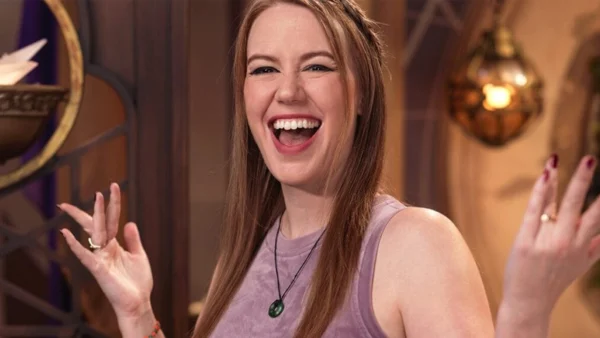

Early Career and Background
Marisha Ray Huber was born on May 10, 1989, in Kentucky, an origin story with no lightning strike, which irritates everyone who prefers one. Her training reads like a dutiful checklist. She worked and trained at the Actors Theatre of Louisville, the American Academy of the Dramatic Arts, the Point Park University Conservatory of Performing Arts, and the Governor’s School for the Arts (a sensible person would have stopped at one institution, but she collected four, like commemorative spoons).
In Los Angeles she became Creative Director at Geek & Sundry, part of Legendary Digital Networks, and spent more than ten years producing web content. She also picked up two Outstanding Achievement Awards from LA Web Fest. In 2012 she created and starred in the fan web series Batgirl: Spoiled, which sits on her IMDb page next to her later credits as Keyleth in The Legend of Vox Machina and Beau in The Mighty Nein. A fan project from 2012 that still appears beside two Prime Video series is a rude reminder that hobbies can be load-bearing.
Breakthrough: Critical Role
The web series Critical Role began airing in 2015 on Geek & Sundry, with Ray as one of the players in a Dungeons & Dragons campaign run by her future husband, Matthew Mercer. Nobody pitched this as a career plan. Strangers simply watched professional voice actors roll dice for hours, and the audience kept growing anyway. Ray played a different lead character in each of the first three campaigns.
Keyleth in The Legend of Vox Machina
Keyleth, a half-elf druid of the Air Ashari, was Ray’s first major Critical Role character. In 2019 the cast left Geek & Sundry to form Critical Role Productions, with Ray as creative director. They asked Kickstarter backers for $750,000 to animate the first campaign and received more than $11 million. (The excess went to animation, which is an alarmingly responsible use of a windfall.) The result, The Legend of Vox Machina, reached Prime Video in January 2022 with Ray voicing Keyleth. Prime Video renewed it for a fourth season in October 2024, as season three was wrapping up.
Beau in The Mighty Nein
Beauregard Lionett, the human monk of the second campaign, became Ray’s second animated lead when The Mighty Nein premiered on Prime Video on November 19, 2025. At New York Comic Con that autumn, Ray told fans the series adds backstory showing where Beau comes from before she meets the rest of the group. The cast also includes Ming-Na Wen as Dairon, a Cobalt Soul agent who mentors Beau.
Laudna and Other Work
In the third campaign, which ran from October 21, 2021, to February 6, 2025, Ray played Laudna, a Hollow One sorcerer and warlock who is cheerful on the surface and spooky underneath. In video games she voiced Margaret in Persona 4 Arena Ultimax.
Recent Work: Season Four
The newest chapter arrived in June 2026, when The Legend of Vox Machina returned for a twelve-episode fourth season. Keyleth’s story that season centers on her Aramente, the elemental trial that defines her arc. In an interview coverage reported by Popverse, Ray said she left the sound stage in tears the first time she played those events in Campaign 1, and that revisiting them for animation felt raw. Few performers get to record the worst day of their own past performance on purpose, and it looks every bit as pleasant as it sounds.
Craft Analysis: Why the Performances Work
None of what follows comes from working with her. Nobody here has shared a booth with Ray, so this is peer observation from within the same industry, nothing more.
The first thing a working voice actor notices is range of placement. Keyleth’s delivery leans on lighter, rising, tentative phrasing, which makes her enormous power read as a surprise even to her. Beau sits lower and flatter, with clipped consonants and deadpan timing that let a single dry line do the work of a paragraph. Laudna runs on breath control, swinging between a bright social cadence and something colder and hollower. Those are three different instruments from one performer, and the voice for each stays steady for years.
The second skill is improvisation under endurance conditions. A live-play session runs four hours or more with no script, so the actor chooses her tone on the spot and holds a character voice that long without it going ragged. (This is roughly the length of a flight to Hawaii, minus the pretzels.) Animation then reverses the demand. She has to re-create a spontaneous moment on a scripted schedule, hit the same emotional beat across multiple takes, and match a performance the audience already knows by heart. Keeping the first take’s spontaneity in the tenth take is the hard part.
Industry Impact and Career Significance
Voice acting has traditionally paid performers by the session and left ownership of the character with someone else. Ray and the Critical Role cast went a different way. They built the company, kept the intellectual property, and put two animated series on Prime Video, with Critical Role itself still airing new campaigns. As creative director, Ray helps shape that whole catalog, which makes her less a hired voice than a co-owner of the building the voices live in. The rest of the business now has to explain why that arrangement should stay unusual.
Somewhere in Exandria, a half-elf druid is probably apologizing to a tree, a monk is rolling her eyes at a mentor, and a ghoulish sorcerer is being unreasonably polite about it. Their shared actor has a production calendar that would make a railroad conductor lie down on the tracks. Check back next season. The monk will have opinions.
Now Read The VO Dirt!Voice Actors D.C. Douglas Knows and Loves!


OR CHECK OUT THE LATEST BLOG DROPPING:He’s back, SacAnime 2027!
Film & Television work. 🎙️HEAR MY VOICE:
Voice Over work. 🎪CONVENTIONS:
Book me for your con! 🩶THE DC STORE:
Learn about Cameos!
I'm such a whore. 🎪LIVE IN PERSON:
Public nuisance posts. 🗣️INTERVIEWS:
Posts from my butt. 🍷GREEN ROOM:
BTS & L.A. life. 🧪RESIDENT EVIL WORLD:
Wesker fetish? 💫TALENT SPOTLIGHT:
Stalker crib notes.